
🇧🇦 Bosnia and Herzegovina · Places to discover
What to see in Sarajevo ?
22 places curated by Hozy - landmarks, nature, hidden restaurants and activities. Click to discover each address in detail.
Landmarks & heritage (9)
Wikipedia (fr) - CC BY-SALandmark
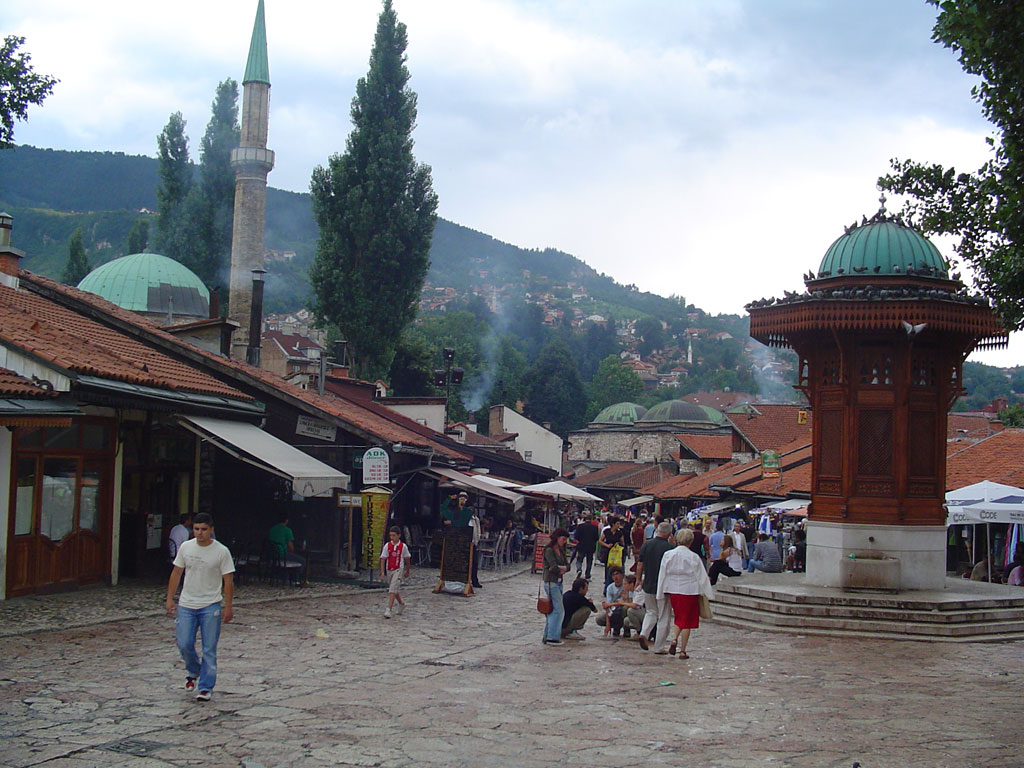
Baščaršija
The Ottoman heart of Sarajevo, a 15th-century bazaar where artisans still work copper by hand. Wander through the covered streets between the čaršija workshops and the Sebilj fountain – the authentic soul of the city.
 Wikipedia (fr) - CC BY-SA
Landmark
Sarajevo Synagogue (Il Kal Grande)
The largest synagogue in the Balkans, built in 1902 in a Moorish-neo-Roman style, testament to the long Sephardic presence in Sarajevo. Now a Jewish museum, it houses the famous Sarajevo Haggadah.
 Wikipedia (fr) - CC BY-SA
Landmark
Gazi Husrev-beg Mosque
The largest Ottoman mosque in the Balkans, built in 1531, a masterpiece of classical Ottoman architecture. Its minaret and interior courtyard with ablution fountain exude remarkable serenity.
 Wikipedia (fr) - CC BY-SA
Landmark
Latin Bridge
This small Ottoman stone bridge is one of the most historically charged places in the world: this is where Archduke Franz Ferdinand was assassinated in 1914, triggering the First World War. Modest but profoundly moving.
 Wikipedia (fr) - CC BY-SA
Landmark
Kovači Cemetery
War cemetery in terraces on the heights of Baščaršija, with thousands of identical white stelae, a place of contemplation of melancholic beauty. President Alija Izetbegović's tomb is located here.
 Wikipedia (fr) - CC BY-SA
Landmark
Sacred Heart Cathedral
The largest Catholic cathedral in Bosnia and Herzegovina, built in 1889 in an elegant neo-Gothic style. Its sober and luminous interior contrasts with the bustle of the pedestrian street nearby.
 Wikipedia (fr) - CC BY-SA
Landmark
Tunnel of War
This 800-metre tunnel dug beneath the airport runway was the only link between besieged Sarajevo and the free world between 1993 and 1995. The family museum that runs it is one of the most poignant testimonies to the siege.
 Wikipedia (fr) - CC BY-SA
Landmark
Bijela Tabija Fortress (White Tower)
The ruins of this Ottoman fortress perched on Jekovac hill offer a 360° panorama over the entire Sarajevo valley. A 20-minute walk from Baščaršija, away from the crowds.
 Wikipedia (fr) - CC BY-SA
Landmark
Old Orthodox Church (Stara pravoslavna crkva)
One of the oldest Orthodox churches in the Balkans, dating from the 16th century, tucked discreetly in the old bazaar. Its iconographic treasures and medieval cemetery make it a little-known gem.
Nature & parks (3)
Wikipedia (en) - CC BY-SANature
Grbavica Neighbourhood
This residential neighbourhood across the Miljacka, occupied during the siege, still bears visible traces of bullet holes on its façades. Walking here with a local resident allows you to understand the geography of the conflict better than any museum.
 Wikipedia (fr) - CC BY-SA
Nature
Trebević Hill and Cable Car
The mountain overlooking Sarajevo, accessible by a renovated cable car since 2018, offering spectacular views over the Sarajevo basin. The 1984 Olympic bobsleigh run is still visible, now covered in graffiti and reclaimed by nature.
 Wikipedia (fr) - CC BY-SA
Nature
1984 Winter Olympics Bobsleigh Track (Trebević)
A spectacular remnant of the 1984 Winter Olympics, this concrete track winds through Trebević forest, entirely covered in giant graffiti. A post-apocalyptic site of strange beauty.
Viewpoints (4)
 Wikipedia (fr) - CC BY-SA
Viewpoint
Hum Hill and its Cross
The highest hill dominating Sarajevo from the west, crowned with a monumental cross visible from across the city. The climb offers unique perspectives over the urban sprawl of the Sarajevo basin.
 Wikipedia (fr) - CC BY-SA
Viewpoint
Festina Lente Bridge
This contemporary pedestrian bridge with a spiral design spans the Miljacka with elegance. A symbol of Sarajevo's renaissance, it is particularly photogenic at dusk from the riverbanks.
Viewpoint
Miljacka Waterfront Promenade
The boulevard running along the Miljacka river between the Latin Bridge and the Vijećnica is the open-air living room of Sarajevans. Riverside cafés, joggers and students mingle in a relaxed and authentic atmosphere.
Viewpoint
Žuta Tabija Hill
Less frequented than Bijela Tabija, this Ottoman fortress offers one of the finest views over the old town at sunset. The path through the residential quarter is itself a discovery.
Activities (6)
 Wikipedia (en) - CC BY-SA
Activity
Museum of the History of Sarajevo (1878–1918)
Housed in the former home where the family of Franz Ferdinand's assassin lived, this small museum traces the city's history under Austro-Hungarian occupation with a fascinating collection of everyday objects.
 Wikipedia (fr) - CC BY-SA
Activity
Markale Market
This indoor open-air market remains the food heart of Sarajevo, tragically remembered for the massacres of 1994 and 1995. Today, stalls of vegetables, cheese and dried meat stand as testimony to the city's resilience.
 Wikipedia (fr) - CC BY-SA
Activity
Gallery 11/07/95
A photographic gallery dedicated to the Srebrenica genocide, austere and devastating, shaped by the visual testimonies of Tarik Samarah. One of the most significant memorial experiences in the Balkans.
 Wikipedia (fr) - CC BY-SA
Activity
Kazandžiluk Copper Workshop
The coppersmiths' lane in Baščaršija, where artisans still hammer copper by hand to craft džezve (coffee pots), trays and bowls. Witness the work and leave with a džezva forged on site.
 Wikipedia (fr) - CC BY-SA
Activity
National Museum of Bosnia and Herzegovina (Zemaljski muzej)
The country's oldest museum, founded in 1888, houses the legendary Sarajevo Haggadah and a collection of stećci (medieval Bogomil gravestones). Its indoor botanical garden is a well-kept secret among Sarajevans.
 Wikipedia (en) - CC BY-SA
Activity
Vijećnica (Sarajevo City Hall)
This Austro-Hungarian Neo-Moorish masterpiece from 1896, deliberately set alight in 1992 destroying 2 million books, has been magnificently restored. Its colourful interiors and reconstructed library are breathtaking.