🇭🇷Croatia · Places to discover
What to see in Split?
23 places selected by the community - landmarks, nature, hidden restaurants and activities.
Split resembles no other Mediterranean coastal city: its historic centre is literally built inside Diocletian's Palace, a fourth-century Roman complex where thousands of people still live today. Flats, bars and corner shops are interwoven between ancient columns, giving the old town a density and authentic life that any static archaeological site never could.
The best time to visit is May or September: the heat is bearable, prices reasonable and the Riva, the main waterfront, remains lively without being saturated. Two days are enough to explore the palace and climb up to Klis fort just outside the city. From Split, ferries to the islands run frequently and cheaply-it's the real way to get about. Skip restaurants right on the Riva: the bill doubles for no good reason.
Landmarks & heritage
2 places
- 1
Landmark
Landmark
Baptistery of Split (Crkva sv. Ivana)
Small medieval church adjoining the cathedral, featuring a remarkable 11th-century Roman relief depicting a Croatian king. A hidden gem in the heart of the palace.
- 2
Landmark
Landmark
Golden Gate (Zlatna Vrata)
The most imposing of the palace's four gates, on the north side, adorned with sculptured niches. Ivan Meštrović's statue of Gregory of Nin stands just outside – local tradition holds that rubbing his thumb brings good fortune.
Museums
2 places
- 3
Museum
Museum
Archaeological Museum of Split
One of Croatia's oldest museums, founded in 1820, housing an exceptional Roman epigraphic collection. The open-air stone garden is often overlooked by hurried visitors.
- 4
Museum
Museum
Ivan Meštrović Gallery
Villa-museum of Croatia's greatest sculptor, designed by himself as both residence and gallery. The permanent collection of outdoor sculpture and interior spaces possess a rare artistic coherence.
Religious sites
2 places
 5Wikimedia Commons · CC BY-SA 2.0
Religious site
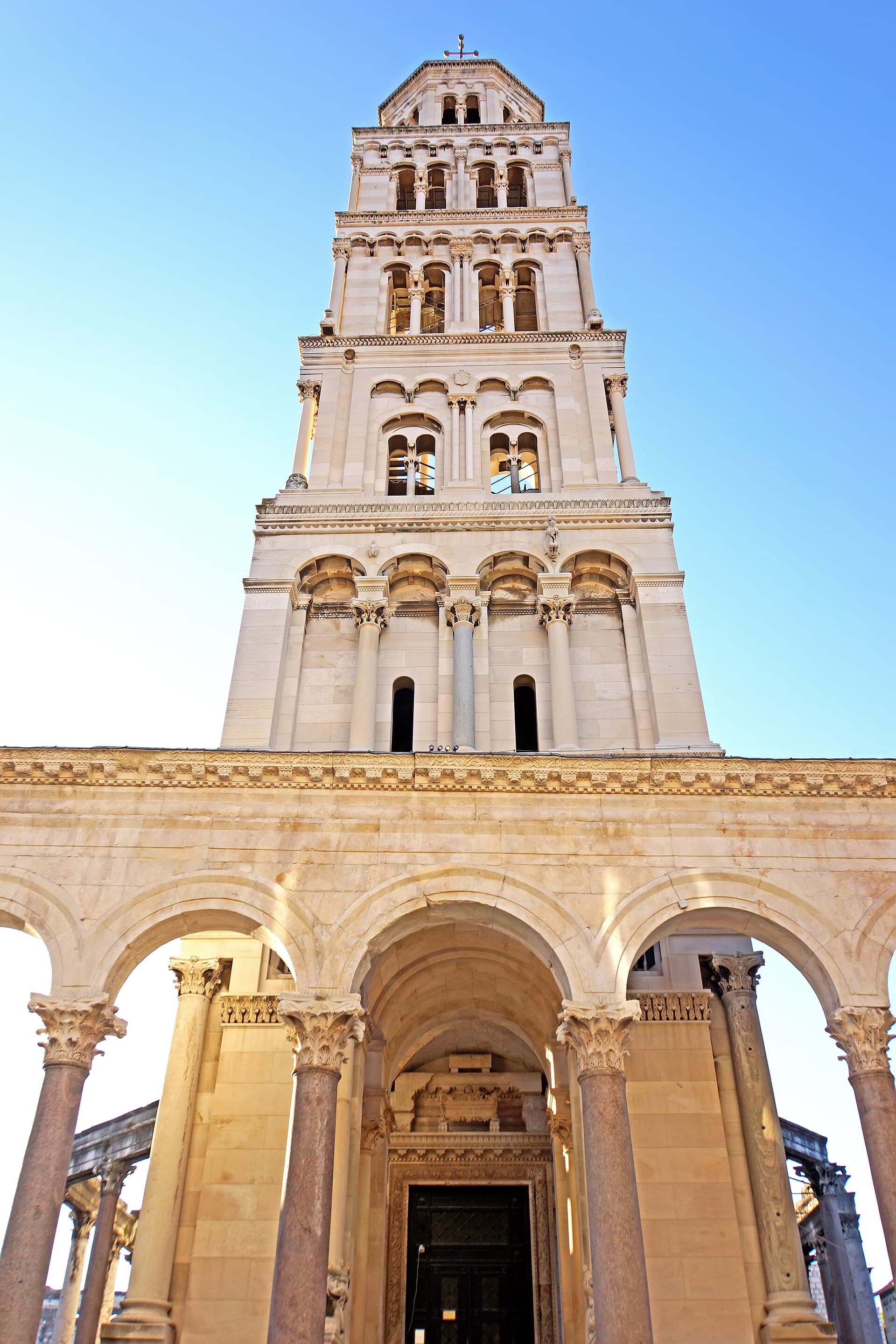
Saint Domnius Cathedral
Diocletian's former burial chamber transformed into a Christian cathedral – a fascinating historical paradox. Its bell tower offers an unobstructed view over the palace roofs and the sea.
- 6
Religious site
Religious site
Jupiter's Temple
A small intact Roman temple converted into a baptistry, nestled in an alleyway within the palace. One of the most intimate and least-visited spaces of the ancient complex.
Castles & fortresses
3 places
- 7
Castle
Castle
Crypt of Diocletian's Palace
The palace's basement preserves intact the Roman structure from the 4th century. The space is now used for contemporary art exhibitions—a striking contrast between antiquity and modernity.
- 8
Castle
Castle
Vestibule of Diocletian's Palace
Open-air rotunda where local singers sometimes perform a cappella klapa chants. The acoustics and atmosphere are otherworldly, especially in the evening.
- 9
Castle
Castle
Diocletian's Palace
One of the best-preserved Roman palaces in the world, still inhabited today. Getting lost in its alleyways at dawn, before the tourist crowds, reveals a living city embedded within antiquity.
Nature
2 places
 10Wikimedia Commons · CC BY-SA 4.0
Nature
Marjan Hill
Split's green lung overlooking the sea, with hiking trails, hidden coves and panoramic views of the Dalmatian islands. Locals come here to run or picnic far from tourists.
- 11
Nature
Nature
Chapels Trail (Marjan)
Path connecting several small medieval chapels carved into the Marjan rock. Melancholic atmosphere and sea views amongst Mediterranean pines.
Viewpoints
3 places
- 12
Viewpoint
Viewpoint
Peristyle of Diocletian's Palace
The central courtyard of the palace, surrounded by Roman columns, where locals still gather in the evenings. In summer, klapa concerts are held here – a unique experience amongst ancient stones.
- 13
Viewpoint
Viewpoint
Vidilica Viewpoint
Panoramic terrace on the heights of Marjan with a classic view over Split and Kaštela Bay. A popular café with local joggers and morning walkers.
- 14
Viewpoint
Viewpoint
Riva Promenade
Split's waterfront, an essential place for locals to stroll at any time of day. The cafés beneath the palm trees are perfect for observing Dalmatian life at the pace of the local dolce vita.
Activities
3 places
 15Wikimedia Commons · CC BY-SA 4.0
Activity
Bačvice Picigin Court
Every morning, local players practice picigin, a water sport inscribed on UNESCO's intangible cultural heritage list. A free and fascinating spectacle, symbol of Split's identity.
- 16
Activity
Activity
Mornar Kayak Club (departing Bačvice)
Kayak and SUP rentals from Bačvice Beach to paddle along the Marjan coastline. Unique views of Split from the sea, away from the crowds.
- 17
Activity
Activity
Pazar Market (Pazarska tržnica)
The open-air market that runs every morning just east of the palace walls. Fruit, vegetables, cheeses and lavender from Hvar – the daily pulse of the city, far from souvenir shops.
Beaches
3 places
- 18
Beach
Beach
Jezinac Beach
Shingle and rocky beach at the foot of Marjan, accessible on foot from the centre. Frequented by neighbourhood families, with remarkably clean water.
- 19
Beach
Beach
Kaštelet Beach (Špinut)
Small rocky cove at the foot of Marjan Park, frequented by neighbourhood residents. Crystal-clear water, peaceful atmosphere, away from the seafront hustle.
- 20
Beach
Beach
Bačvice Beach
Fine sandy beach, exceptionally rare in Dalmatia, birthplace of picigin – a distinctly Split water game played whilst standing in shallow water. Authentic local atmosphere, especially in the morning.
More to discover
3 places
 21Wikimedia Commons
Place
Varoš Neighbourhood
The old working-class quarter at the foot of Marjan, with paved alleyways, stone houses and flower-draped stairways. Less photographed than the palace but absolutely authentic.
- 22
Place
Place
Bar Stari Plac (Stari Grad)
Discreet wine bar in a vaulted cellar of the palace, run by enthusiasts of Dalmatian viticulture. Ideal for discovering Plavac Mali and Pošip away from touristy cocktail bars.
- 23
Place
Place
Bregovita Market (Spinut Market)
Small neighbourhood market in the residential area of Spinut, away from tourist circuits. Where locals do their shopping in Split.
Also 🇭🇷 in Croatia