🇷🇸Serbia · Places to discover
What to see in Belgrade?
23 places selected by the community - landmarks, nature, hidden restaurants and activities.
Belgrade resembles no other European capital. Built and rebuilt dozens of times at the crossroads of East and West, it wears its scars without hiding them. Kalemegdan fortress dominates the confluence of the Sava and Danube with quiet authority, while the Skadarlija quarter keeps alive a bohemia of cobbled streets and kafanas that locals still genuinely frequent.
Spring (April-May) and autumn (September-October) offer ideal conditions for walking at leisure. Budget three to four days to get beyond the surface. Public transport covers the city well, but the centre is easily navigable on foot. Avoid concentrating your evenings on the floating clubs of Splavovi: it's worth one night, but not the heart of the city.
Landmarks & heritage
3 places
 1Wikimedia Commons
Landmark
Staro Sajmište (Old Fairground)
Site of a Nazi concentration camp during the Second World War, now a memorial space undergoing rehabilitation on the Sava riverbank. A solemn and seldom-visited place deserving of respect.
 2Wikimedia Commons · CC BY 2.0
Landmark
Zemun – Gardoš and Sibinjanin Janko Tower
The former Austro-Hungarian village of Zemun offers sweeping views of the Danube and red-tiled roofs from its medieval tower. A distinct town-within-a-town atmosphere, 20 minutes from the centre.
 3Wikimedia Commons · CC BY 2.0
Landmark
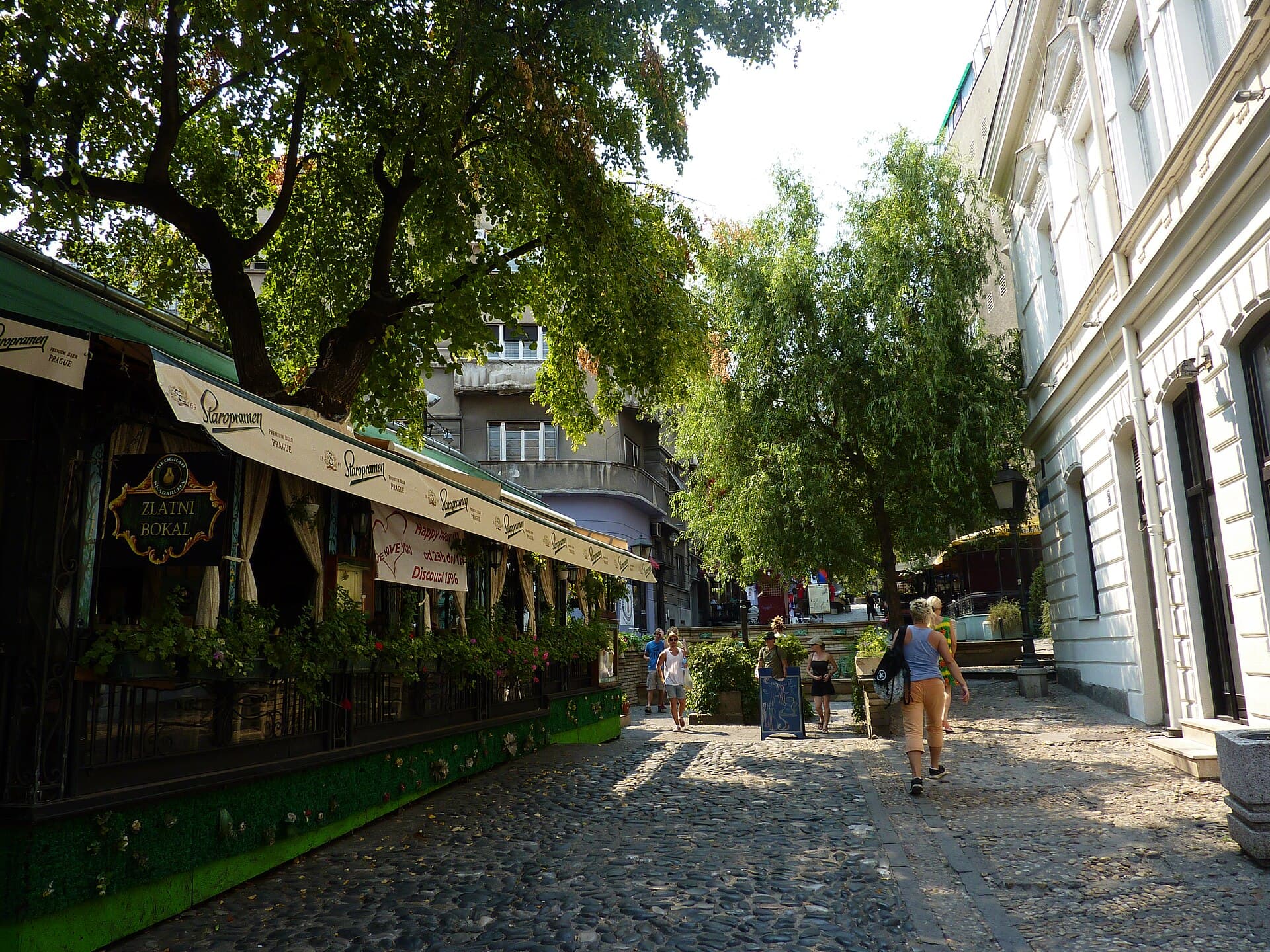
Skadarlija Quarter
The bohemian alley of the 19th century, paved with cobblestones and lined with traditional kafanas where Serbian poets came to drink wine. The soul of old Belgrade, far from standardised tourist circuits.
Museums
4 places
 4Wikimedia Commons · CC BY-SA 3.0
Museum
Nikola Tesla Museum
Museum dedicated to the Serbo-American inventor, with his funeral urns, original apparatus and spectacular electrical demonstrations. Small but dense, not to be missed.
 5Wikimedia Commons · CC BY-SA 4.0
Museum
National Museum of Serbia
Reopened in 2018 after 15 years of closure, it houses the twelfth-century Miroslav Gospels collection and works by Renoir and Matisse acquired in the 1930s. Underrated by rushed visitors.
 6Wikimedia Commons · CC BY-SA 3.0
Museum
Yugoslav History Museum – Tito's Tomb
The austere mausoleum of Josip Broz Tito within the House of Flowers complex, surrounded by state gifts from around the world. A fascinating place of remembrance for non-aligned Yugoslavia.
- 7
Museum
Museum
Museum of Illusions Belgrade
Interactive space in the city centre featuring holograms, infinite tunnels and optical illusions. Ideal with children or for a playful hour's break between cultural visits.
Religious sites
2 places
- 8
Religious site
Religious site
Saint Mark's Church
Built in 1940 in the Serbo-Byzantine Raška style, it houses the sarcophagus of Emperor Stefan Dušan. Less visited than Saint Sava but architecturally remarkable.
- 9
Religious site
Religious site
Saint Sava Cathedral
One of the world's largest Orthodox churches, built on the site where the Ottomans allegedly burned the relics of Serbia's patron saint. The interior mosaic, still being completed, is breathtaking.
Castles & fortresses
2 places
 10Wikimedia Commons · CC BY-SA 4.0
Castle
Kalemegdan Fortress
A medieval citadel overlooking the confluence of the Sava and Danube rivers, inhabited since the Bronze Age. The sunset from the ramparts is one of the finest in the Balkans.
- 11
Castle
Castle
Princess Ljubica's Palace
Early nineteenth-century princely residence blending Balkan architecture with Ottoman influences, restored with period interiors. A rare testament to post-Ottoman Serbia.
Parks & gardens
2 places
 12Wikimedia Commons · CC BY-SA 3.0
Park
Topčider Park
Belgrade's green lung, planted with century-old plane trees around Prince Miloš's palace, where families picnic on Sundays. An authentic space that tourists scarcely notice.
 13Wikimedia Commons · CC BY-SA 4.0
Park
Košutnjak Park
Urban forest spanning 330 hectares with hiking trails, mountain bike tracks and an open-air Olympic swimming pool. Joggers and families come here each morning, far from the tourist crowds.
Viewpoints
4 places
 14Wikimedia Commons · CC BY-SA 4.0
Viewpoint
Zvezdara Park Viewpoint
A wooded hill to the east of the city centre with an astronomical observatory and an unobstructed view of Belgrade's skyline. A favourite spot for locals to picnic at sunset.
 15Wikimedia Commons · CC BY-SA 4.0
Viewpoint
Savamala District
Former riverside warehouse converted into a cultural hub with galleries, studios and underground bars. The heart of Belgrade's creative scene, particularly vibrant on Friday evenings.
- 16
Viewpoint
Viewpoint
Zemun Riverbank on the Danube
Zemun's waterfront with floating fish restaurants and moored boats is where Belgraders dine while watching the river. Unexpectedly Mediterranean atmosphere.
- 17
Viewpoint
Viewpoint
Confluence of Sava and Danube from Kalemegdan Viewpoint
The view from the fortress's lower terrace where the two rivers meet is unique in Europe. At sunset, the golden light on the water is unforgettable.
Activities
1 place
- 18
Activity
Activity
Night Cruise on the Sava and Danube
Restaurant boats (šlepovi) moored along the banks offer cruises with turbo-folk or jazz music depending on the evening. A unique way to see Belgrade from the water.
Beaches
2 places
 19Wikimedia Commons · CC BY-SA 4.0
Beach
Ada Ciganlija
Artificial island beach on the Sava, transformed into a lake, where Belgraders swim, cycle and barbecue from May to September. The true local summer gathering place, not a tourist attraction.
- 20
Beach
Beach
Ada Huja – Wild Danube Beach
Unmanicured natural beach on the Danube, frequented by nudists and Belgrade fishermen for generations. Accessible by bike from the city centre, entirely local atmosphere.
More to discover
3 places
- 21
Place
Place
Vračar District – Njegoševa Street
Belgrade's most elegant residential thoroughfare, lined with Art Deco buildings and neighbourhood cafés frequented by intellectuals and families. True Belgrade bourgeois life.
- 22
Place
Place
Novo Groblje Cemetery
Belgrade's major historical cemetery, with graves of prominent Serbian figures and remarkable Art Nouveau and academic funerary statuary. A melancholic and architecturally rich walk.
- 23
Place
Place
Plato Bookshop
Belgrade's leading independent bookshop, with a curated selection in foreign languages, readings and regular cultural events. Meeting place of the local intelligentsia.
Also 🇷🇸 in Serbia