🇭🇷Croatia · Places to discover
What to see in Zagreb?
23 places selected by the community - landmarks, nature, hidden restaurants and activities.
Landmarks & heritage
5 places
 1Wikimedia Commons · CC BY-SA 4.0
Landmark
Dolac Market
The open-air Dolac market, nicknamed 'the belly of Zagreb', has thrived every morning since 1930. Women in red aprons sell garden vegetables, Pag island cheese and fresh flowers – arrive before 9am for the authentic atmosphere.
 2Wikimedia Commons · CC BY-SA 3.0
Landmark
Trg bana Josipa Jelačića
Zagreb's grand central square dominated by the equestrian statue of Ban Jelačić, an essential meeting point for residents since the nineteenth century. Watching the ballet of trams and hurrying Zagrebians from a café terrace is a simple, authentic pleasure.
 3Wikimedia Commons · CC BY-SA 4.0
Landmark
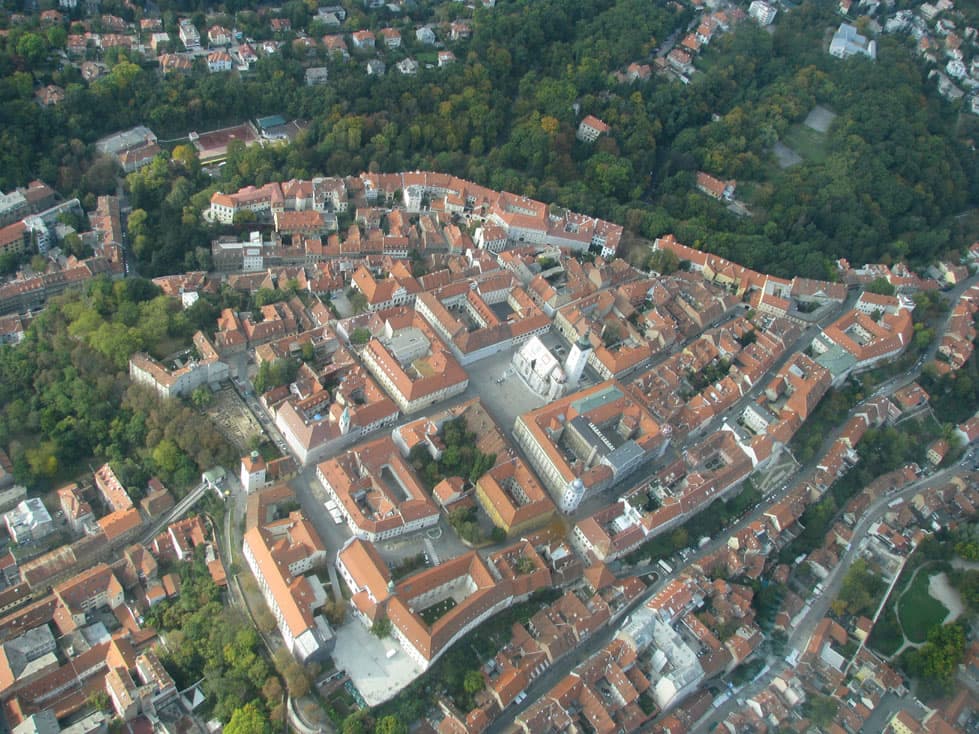
Gornji Grad – Gradec
The medieval heart of Zagreb perched on its hilltop, where cobbled streets wind past colourful Baroque houses and hidden courtyards. The locals stroll here Sunday mornings when tourists are still asleep.
 4Wikimedia Commons · CC BY-SA 4.0
Landmark
Lotrščak Tower
This 13th-century medieval tower fires a cannon daily at noon – an unbroken tradition since 1877. The panorama from the top across Donji Grad and the terracotta rooftops amply rewards the modest entrance fee.
 5Wikimedia Commons · CC BY 2.0
Landmark
Mirogoj Cemetery
Designed by Hermann Bollé in 1876, this cemetery-park ranks among Europe's finest, with ivy-draped neo-Renaissance arcades and remarkable funerary sculptures. It serves locals as a contemplative and peaceful place for reflection.
Museums
5 places
 6Wikimedia Commons · CC BY-SA 3.0
Museum
Hrvatska Akademija Znanosti i Umjetnosti – Galerija Strossmayer
The Strossmayer Gallery in the Croatian Academy palace houses the country's oldest collection of Old Master paintings, from the fourteenth to eighteenth centuries. Little known to visitors, it possesses remarkable museum-quality works.
 7Wikimedia Commons · CC BY-SA 4.0
Museum
Museum of Arts and Crafts
Housed in a striking neo-Renaissance palace from 1888, this museum traces European design from the Middle Ages to the 20th century. Its collection of furniture, timepieces, textiles and glassware possesses rare elegance.
 8Wikimedia Commons · CC BY-SA 4.0
Museum
Mimara Museum
An encyclopaedic collection of 3,750 works assembled by collector Ante Topić Mimara, spanning from Roman glass to canvases by Rubens and Velázquez. Overlooked by foreign visitors, it ranks among the Balkans' finest museums.
 9Wikimedia Commons · CC BY-SA 3.0
Museum
Muzej suvremene umjetnosti Zagreb
The Museum of Contemporary Art in its glass and concrete building designed by Igor Franić showcases Yugoslav and Croatian art from the 1960s to the present day. An ambitious and honest museum on an artistic period unjustly overlooked in the West.
- 10
Museum
Museum
Museum of Broken Relationships
A unique institution worldwide: objects donated by former lovers across the globe, each accompanied by its own story. Moving, witty and profoundly human – one of Europe's most original museums.
Religious sites
2 places
 11Wikimedia Commons · CC BY-SA 4.0
Religious site
Cathedral of the Assumption of the Blessed Virgin Mary
Zagreb's neo-Gothic cathedral, rebuilt following the 1880 earthquake, dominates the city with its twin spires rising 108 metres. The interior houses medieval frescoes and the tomb of Cardinal Stepinac, a controversial figure in Croatian history.
 12Wikimedia Commons · CC BY 2.0
Religious site
Church of St Mark
The 13th-century Church of St Mark, with its distinctive glazed-tile roof bearing the coats of arms of Zagreb and Croatia, is the city's most iconic image. The square surrounding it remains surprisingly serene despite its renown.
Nature
3 places
 13Wikimedia Commons · CC BY-SA 3.0
Nature
Jezero Jarun
An artificial lake created for the 1987 Universiade, now the aquatic playground of Zagrebians: sailing, kayaking, swimming and waterside bar terraces. The summer atmosphere is festive and distinctly local.
 14Wikimedia Commons · CC BY-SA 4.0
Nature
Medvednica – Sljeme
Mount Medvednica peaks at 1,033 metres just north of Zagreb, accessible by cable car or on foot in 2 hours from the city. In winter it's an urban ski resort; in summer, a network of forest trails where locals escape the heat.
- 15
Nature
Nature
Zelengaj – Šetnica uz Tuškanac
A forest path that winds through Tuškanac park within minutes of the city centre, dotted with benches and romantic ruins. Locals walk their dogs here early in the morning in an almost rural silence.
Parks & gardens
2 places
 16Wikimedia Commons · CC BY-SA 4.0
Park
Botanički vrt Sveučilišta u Zagrebu
The university's botanical garden, founded in 1889, houses 10,000 plant species and Victorian cast-iron greenhouses. A refuge of greenery and quiet in the heart of the city, virtually overlooked by tourists.
 17Wikimedia Commons · CC BY-SA 4.0
Park
Park Maksimir
An immense 316-hectare landscaped park that opened in 1794 as Central Europe's first public park. Five lakes, century-old oak forests and romantic pavilions make it the green lung where Zagrebians run, picnic and walk their dogs.
Viewpoints
2 places
 18Wikimedia Commons · CC BY-SA 4.0
Viewpoint
Tvrđava Medvedgrad
Medieval thirteenth-century fortress perched on the flank of Medvednica, reachable on foot from Zagreb in one and a half hours' climb through forest. The panorama over Zagreb and the Pannonian plain from the ramparts is exceptional.
- 19
Viewpoint
Viewpoint
View from Kula Lotrščak Tower – Strossmayerovo šetalište
The Strossmayer promenade runs along the edge of the Gornji Grad hillside with sweeping views over the orange-tiled roofs of Donji Grad and the cathedral spires. Sunset from this vantage point is a moment locals share with friends.
Activities
4 places
 20Wikimedia Commons · CC BY-SA 3.0
Activity
Uspinjača Funicular
Zagreb's funicular, merely 66 metres long, has connected Donji Grad to Gornji Grad since 1890 – among the world's shortest in regular service. Riding it at least once is a rite of passage for any visitor.
 21Wikimedia Commons · CC BY 2.0
Activity
Tkalčićeva ulica
Winding pedestrian street in Gornji Grad lined with terrace cafés in nineteenth-century townhouses, once the bed of the Medveščak river. Zagreb's social artery where you catch your morning coffee or evening drink – at any hour.
- 22
Activity
Activity
Antikvarijati Britanac – Hrelić
The Hrelić flea market, held Sunday mornings on the site of a former racecourse, is a monumental jumble where you find everything: Yugoslav vinyl records, old tools, Communist furniture, spices and vegetables. A sociological immersion in popular Zagreb.
- 23
Activity
Activity
Advent na Zrinjevcu
The Christmas market on Zrinjevac Square, voted Europe's finest Christmas market several times over. Even out of season, this square with its nineteenth-century bandstand and hundred-year-old horse chestnuts is among Zagreb's most beautiful.
Also 🇭🇷 in Croatia