🇮🇹Italy · Places to discover
What to see in Lecce?
18 places selected by the community - landmarks, nature, hidden restaurants and activities.
Lecce's reputation rests on local stone so soft it carved like butter, and baroque stonemasons exploited this for two centuries. The result reads on every historic centre façade: the Basilica di Santa Croce alone concentrates more detail than most European cathedrals. The town remains above all Salentine-unhurried, proud, uninterested in passing tourism.
September and October offer the best window: summer heat falls away, visitors do too. Two days covers the centre, three if you explore the surrounding masserie. Lecce is walkable; hiring a car makes sense only for leaving town. Avoid Piazza Sant'Oronzo at midday: the terraces charge prices bearing no relation to quality, whilst excellent cafés sit two streets away.
Landmarks & heritage
8 places
 1Wikipedia · CC BY-SA
Landmark
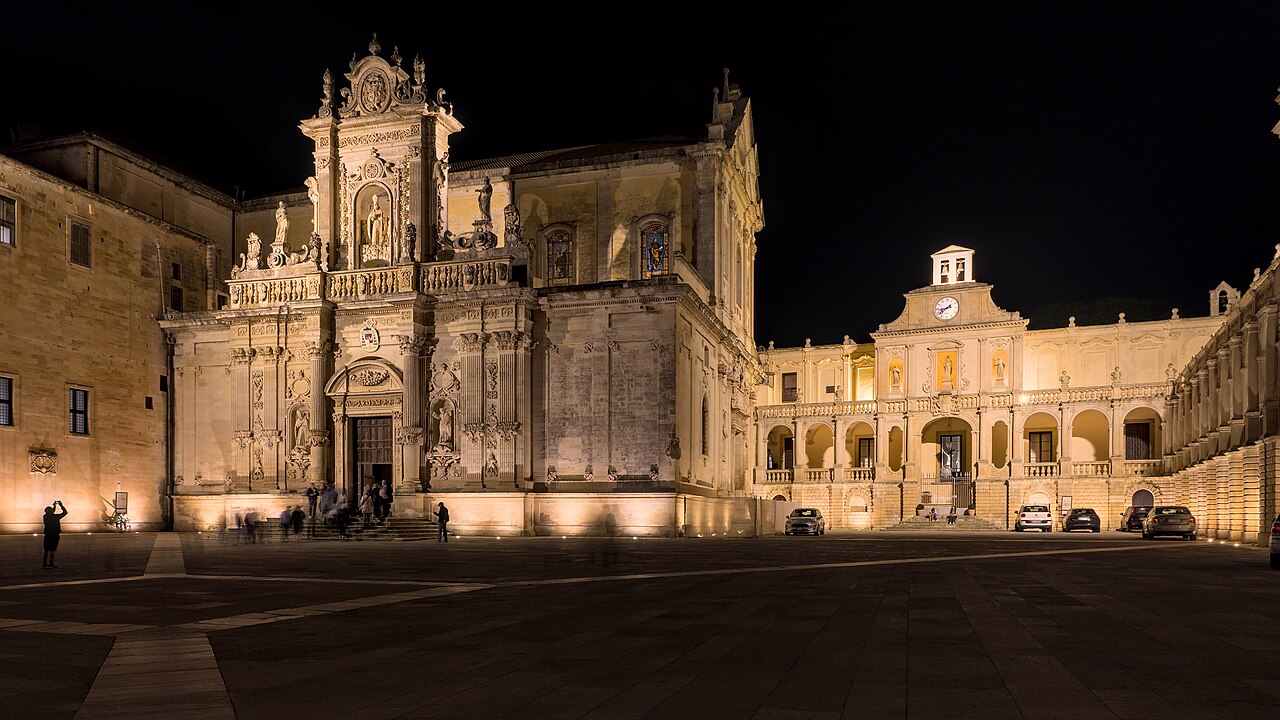
Lecce Cathedral Square
A square enclosed on three sides, a unique baroque stage-set found nowhere else in Italy: cathedral, 68-metre bell tower, bishop's palace and seminary form a coherent, majestic ensemble. Evening, after the tourists depart, the square takes on an almost mystical air.
 2Wikipedia · CC BY-SA
Landmark
Teatro Romano di Lecce
A 1st-century BC Roman theatre discovered in the 1920s, with a partially restored cavea and adjoining small museum. Less known than the amphitheatre, it is nonetheless better preserved architecturally overall. Access is via a discreet alley through the historic centre.
 3Wikipedia · CC BY-SA
Landmark
Basilica di Santa Croce
An absolute masterpiece of Lecce baroque, its sculpted façade refined over two centuries by the finest local artisans. The fantastical creatures and floral garlands in pietra leccese are breathtakingly intricate. See it in late afternoon when golden light reveals every detail.
 4Wikipedia · CC BY-SA
Landmark
Roman Amphitheatre of Lecce
Second-century Roman amphitheatre partly excavated in the middle of Piazza Sant'Oronzo, once holding 25,000 spectators. What you see is merely the tip—the rest remains buried beneath the modern city. Free entry from the piazza side.
 5Wikipedia · CC BY-SA
Landmark
Church of Santi Niccolò e Cataldo
Founded in 1180 by the Normans, this is Lecce's oldest church, hidden within the monumental cemetery beyond the centre. The original Romanesque portal coexists with baroque additions from the 18th century in a unique architectural synthesis. The cemetery itself is an open-air museum of funeral sculpture.
 6Wikipedia · CC BY-SA
Landmark
Arco di Trionfo (Porta Napoli)
A triumphal arch erected in 1548 at the city's northern entrance honouring Charles V, built in golden pietra leccese stone. Less famous than those in Rome yet of remarkable mannerist elegance. It marks the historic gateway into Lecce from Naples.
 7Wikipedia · CC BY-SA
Landmark
Church of San Matteo
A small baroque church from 1700 whose façade plays on a concave-convex alternation inspired by Borromini—exceptionally rare in Puglia. The austere interior contrasts strikingly with the façade's exuberance, making it all the more surprising. Rarely crowded, you can explore it peacefully.
- 8
Landmark
Landmark
Castello di Carlo V
A 16th-century Aragonese fortress at the heart of the city, often overlooked by visitors hurrying between baroque churches. Temporary contemporary art exhibitions create a fascinating dialogue across the centuries. The moats transformed into gardens merit a leisurely pause.
Nature & parks
3 places
 9Wikipedia · CC BY-SA
Nature
Le Cesine - Riserva Naturale Statale
WWF nature reserve on the Adriatic coast, 15 km from Lecce, with lagoons, dunes and unspoilt Mediterranean scrubland. A wetland of international importance for migratory birds, with regular pink flamingos in autumn. Accessible on foot from the coastal road, free entry with guided tours available at weekends.
 10Wikipedia · CC BY-SA
Nature
Parco Naturale Regionale Bosco e Paludi di Rauccio
Nature reserve just 8 km from Lecce's centre, with wetlands, cork-oak forest and coastal pine woodland. An exceptional breeding ground for herons, flamingos and swifts. Local families come here for weekend walks, well away from the historic centre's crowds.
 11Wikipedia · CC BY-SA
Nature
Giardini Pubblici di Lecce
Nineteenth-century public gardens at the heart of the city, planted with rare Mediterranean species and featuring a period bandstand. An authentic gathering spot where locals play bowls, walk their dogs and read the paper. An essential cool refuge during summer.
Viewpoints
1 place
- 12
Viewpoint
Viewpoint
Terrazza panoramica del Campanile del Duomo
From the summit of the 68-metre bell tower, a 360-degree view over the pietra leccese rooftops of the historic centre and, on clear days, the Adriatic and Ionian seas simultaneously. Few visitors make the climb, which makes the experience all the more special. Small admission fee applies.
Activities
5 places
 13Wikipedia · CC BY-SA
Activity
School of Pizzica - Taranta Power
School of pizzica salentina, the traditional Salento dance linked to tarantula folklore, offering beginner classes several evenings a week. Taking a class proves far more revealing than attending a folk performance. In summer, classes often conclude with a session dancing through the centro storico's narrow streets.
 14Wikipedia · CC BY-SA
Activity
Museo Faggiano
A museum born by accident: in 1999, a homeowner excavates to repair drains and unearths 2,000 years of layered history beneath his house. Mesopotamian, Roman, medieval, Templar... Archaeological strata are visible through openings in the floor and walls. An absolutely singular visit.
 15Wikipedia · CC BY-SA
Activity
Museo Provinciale Sigismondo Castromediano
Puglia's oldest museum, founded in 1868, housing a first-rate collection of Messapian, Greek and Roman ceramics. The numismatic section and Neapolitan painting gallery are often overlooked yet well worth exploring. Modest admission and rarely crowded.
- 16
Activity
Activity
Mercato di Piazza Libertini
A morning market where locals have shopped for generations, surrounded by century-old plane trees. Salento vegetables, local cheeses, and fresh fish from the Adriatic and Ionian seas mingle in authentic atmosphere. Arrive before 9am to see the market in full swing.
- 17
Activity
Activity
Laboratorio di ceramica e cartapesta Claudio Riso
A family workshop perpetuating the art of cartapesta leccese, a papier-mâché technique that has adorned regional altars since the 17th century. Claudio Riso welcomes curious visitors and explains the craft's secrets with passion. Unique pieces available for purchase directly from the workshop.
More to discover
1 place
- 18
Place
Place
Via Libertini and Centro Storico Streets - Evening Passeggiata
The evening passeggiata through the centro storico's alleyways is an unchanging social ritual for locals, from 6 pm to 9 pm. Via Libertini, Via Palmieri and adjacent streets transform into an open-air living room where everyone greets one another. Watching this ritual unfold from a café terrace is itself a cultural experience.
Also 🇮🇹 in Italy


