🇵🇱Poland · Places to discover
What to see in Wrocław?
24 places selected by the community - landmarks, nature, hidden restaurants and activities.
Landmarks & heritage
7 places
 1Wikimedia Commons · CC BY-SA 3.0
Landmark
Racławice Panorama
A sweeping cycloramic painting 114 metres long depicting the Battle of Racławice (1794). This monumental, immersive work is unique in Europe and not to be missed — book your ticket in advance.
 2Wikimedia Commons · CC BY-SA 4.0
Landmark
Wrocław Town Hall
A flamboyant Gothic masterpiece from the 14th century dominating the centre of the Rynek. Its eastern façade, decorated with astronomical clocks and sculptures, stands as a unique testament to Silesian civic art.
 3Wikimedia Commons · CC BY-SA 3.0
Landmark
Centennial Hall (Hala Stulecia)
A reinforced concrete modernist masterpiece from 1913, inscribed on UNESCO's World Heritage list. Its 65-metre diameter dome was the world's largest at the time of construction — a structure that commands respect.
 4Wikimedia Commons · CC BY 3.0
Landmark
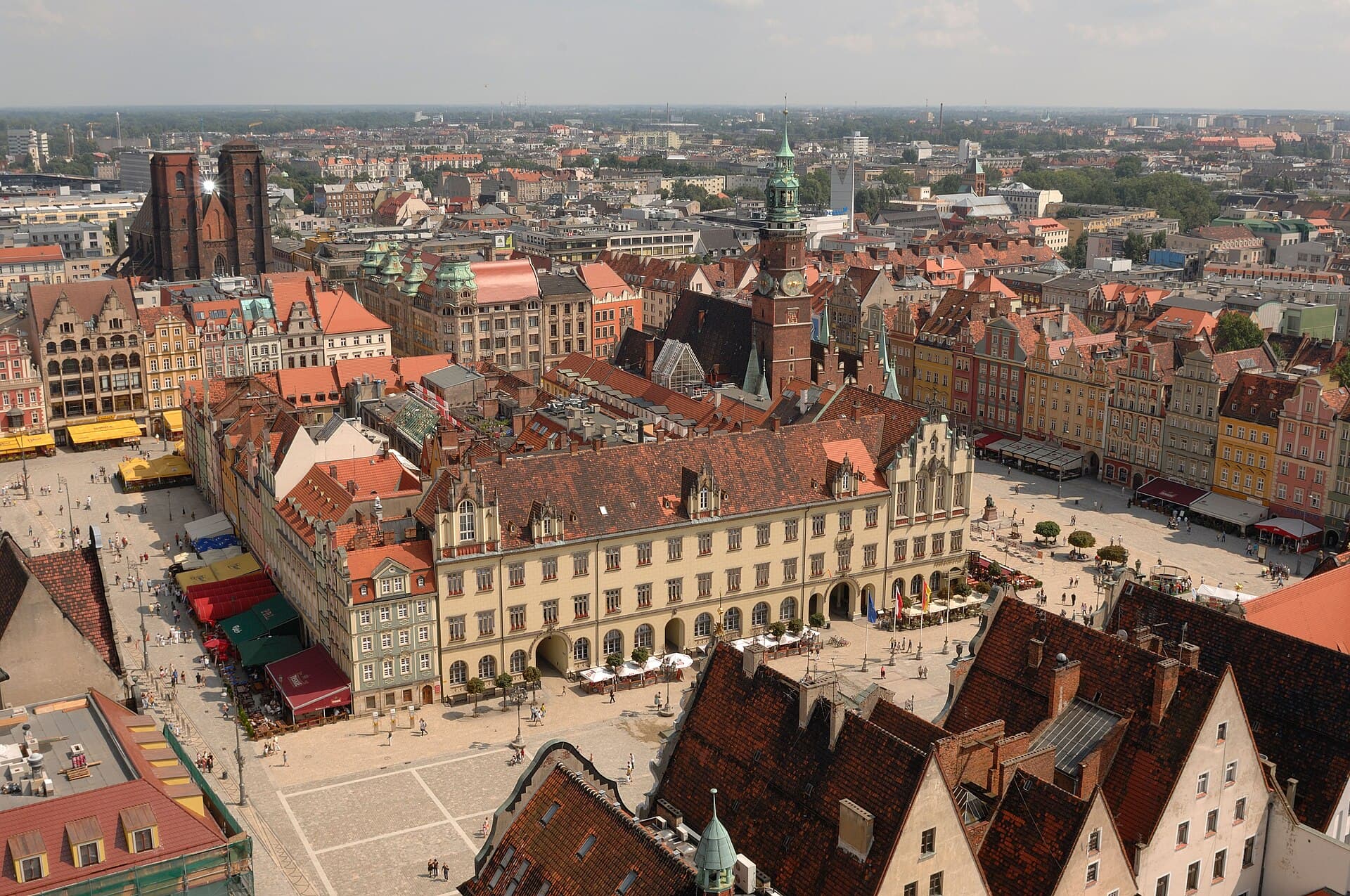
Rynek (Wrocław Market Square)
One of Central Europe's largest medieval squares, ringed by colourful burgher houses. The beating heart of the city, especially in the evening when locals gather for drinks and conversation.
- 5
Landmark
Landmark
District of Four Faiths (Dzielnica Wzajemnego Szacunku Czterech Wyznań)
A unique European neighbourhood where a Catholic church, Protestant church, synagogue and Orthodox church stand within metres of one another. Testament to the city's multicultural past.
- 6
Landmark
Landmark
Aula Leopoldina (Wrocław University)
One of Europe's most beautiful Baroque halls, tucked within the university's main building. Ceiling frescoes, gilded stucco and statuary create a masterpiece that hurried tourists often overlook.
- 7
Landmark
Landmark
Ostrów Tumski (Cathedral Island)
The historical cradle of Wrocław and Poland's only neighbourhood still lit by gas lamps at night. Strolling here at dusk, as the lamplighter passes, is a journey beyond time.
Museums
1 place
 8Wikimedia Commons · CC BY-SA 4.0
Museum
National Museum of Wrocław
Poland's finest collection of medieval Silesian art, featuring exceptional Gothic altarpieces and 14th-century sculptures. The 20th-century Polish modern art department is equally revelatory.
Religious sites
3 places
 9Wikimedia Commons · CC BY-SA 4.0
Religious site
White Synagogue (Synagoga pod Białym Bocianem)
A 19th-century Neoclassical synagogue, among Silesia's rarest surviving examples. The surrounding Jewish quarter (Dzielnica Czterech Wyznań) testifies to Wrocław's multicultural past, with four places of worship standing side by side.
 10Wikimedia Commons
Religious site
St John the Baptist Cathedral, Wrocław
A majestic Gothic cathedral on Cathedral Island (Ostrów Tumski), the city's oldest and most romantic quarter. Climb one of the towers for sweeping views across the rooftops and the Oder's waterways.
- 11
Religious site
Religious site
Church of St Elizabeth, Wrocław
An imposing 14th-century Gothic church whose tower commands the finest views over the old town's rooftops. Less celebrated than the cathedral yet equally impressive, it offers a more intimate atmosphere.
Nature
2 places
- 12
Nature
Nature
Oder Riverside Promenade (Bulwar Dunikowskiego)
The waterfront path along the Oder between Grunwaldzki Bridge and Ostrów Tumski is the city's green lung. It's ideal at sunset for catching the cathedral's reflection shimmering across the water.
- 13
Nature
Nature
Słodowa Island
A small island on the Oder transformed into a bohemian leisure spot, complete with sun loungers and a relaxed atmosphere. The favoured haunt of Wrocław students for soaking up summer sunshine on lazy afternoons.
Parks & gardens
3 places
 14Wikimedia Commons · CC BY-SA 3.0
Park
Japanese Garden of Wrocław
Created in 1913 during the national exhibition, this Japanese garden at the heart of Szczytnicki Park is among Central Europe's oldest and best-preserved. In spring, the cherry blossoms are absolutely breathtaking.
 15Wikimedia Commons · CC BY-SA 3.0
Park
Botanical Gardens of Wrocław University
One of Poland's oldest botanical gardens (founded 1811), featuring tropical greenhouses and an exceptional alpine plant collection. A hidden sanctuary just steps from the centre, largely overlooked by tourists.
 16Wikimedia Commons · CC BY-SA 3.0
Park
Szczytnicki Park
Wrocław's largest park at 100 hectares, featuring an authentic Japanese garden and magnificent rose garden. Locals flock here at weekends to picnic far from the city centre's hustle.
Viewpoints
3 places
 17Wikimedia Commons · CC BY-SA 4.0
Viewpoint
Grunwald Bridge
A suspension bridge of Art Nouveau design from 1910, among Poland's finest and a symbol of Wrocław. The view across the Oder to the university towers is particularly spectacular at sunset.
- 18
Viewpoint
Viewpoint
Tumski Bridge (Most Tumski)
Wrocław's lovers' bridge, festooned with padlocks and connecting both halves of Ostrów Tumski. Illuminated by gas lamps at night, it ranks among the city's most romantic spots.
- 19
Viewpoint
Viewpoint
View from the Mathematical Tower (Wieża Matematyczna)
The university tower, open to the public, offers a sweeping 360° panorama over the old town and the Oder. Less crowded than Saint Elizabeth's Tower, it reveals a different perspective on the city's bridges and islands.
Activities
3 places
 20Wikimedia Commons · CC BY-SA 4.0
Activity
Hydropolis
An interactive water museum housed in a 19th-century underground reservoir. An immersive and original experience, particularly appreciated yet underexplored by foreign visitors.
- 21
Activity
Activity
Hunt for Wrocław's Dwarves
Over 600 tiny bronze dwarf figurines are hidden throughout the city — a tradition born from resistance to communist rule in the 1980s. Hunt for them on pavements, fountains and street corners.
- 22
Activity
Activity
Hala Targowa (Covered Market)
A magnificent Art Nouveau market hall from 1908, where residents have shopped for over a century. Cheese, cured meats, smoked fish and flowers — ideal for an authentic breakfast experience.
More to discover
2 places
 23Wikimedia Commons · CC BY-SA 3.0
Place
Nadodrze District
The rapidly gentrifying neighbourhood north of the centre, featuring restored Art Nouveau façades, independent galleries and trendy cafés. Authentic, vibrant Wrocław well away from the tourist trail.
- 24
Place
Place
Cemetery of the Holy Virgin Mary (Cmentarz Osobowicki)
Wrocław's largest cemetery, with remarkable graves bearing witness to the different communities that inhabited the city—German, Polish, and Jewish. A moving and little-known place of remembrance.
Also 🇵🇱 in Poland