🇪🇸Spain · Places to discover
What to see in Besalú?
22 places selected by the community - landmarks, nature, hidden restaurants and activities.
Besalú is a medieval town in the Catalan Garrotxa that has drifted through the centuries without seeking much attention. Its fortified Romanesque bridge with eleven arches, built in the twelfth century, spans the Fluvià and remains one of the best-preserved structures across the entire Iberian peninsula. The juderia, the Jewish quarter with its ritual baths or mikvé, recalls that the town was a centre of intellectual and commercial importance in the Middle Ages.
Spring and autumn offer ideal light and visitor numbers; summer turns the alleyways into a corridor of organised groups. Allow half a day, or a full day if you combine it with the nearby Garrotxa volcanoes. Besalú is easily reached by car from Girona in forty minutes, as public transport remains impractical. Don't limit yourself to the bridge for photographs: the interior of the town, less photographed, concentrates the place's essential character.
Landmarks & heritage
10 places
 1Wikipedia · CC BY-SA
Landmark
Jewish Mikveh of Besalú
Twelfth-century Jewish ritual bath, one of only three preserved in Europe. Discovered by chance in 1964, this exceptional underground site testifies to Besalú's rich medieval Jewish community.
 2Wikipedia · CC BY-SA
Landmark
Ruins of Besalú Castle
Vestiges of the comtal castle dominating the village from a rocky outcrop, commanding panoramic views over the Fluvià and medieval rooftops. A little-frequented spot where the atmosphere of the former county capital feels genuinely palpable.
 3Wikipedia · CC BY-SA
Landmark
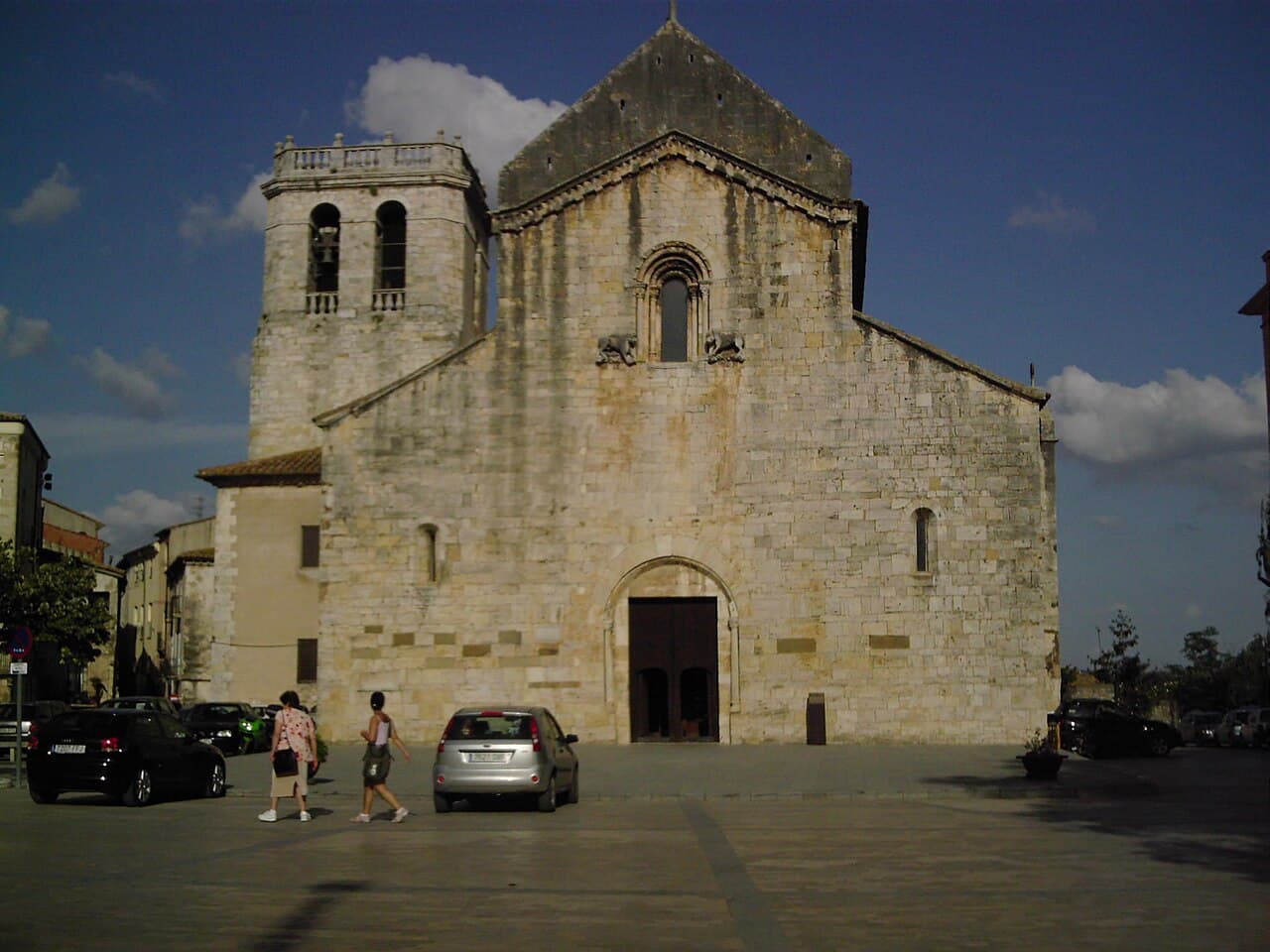
Monastery of Sant Pere de Besalú
Benedictine monastery founded in the tenth century, its carved Romanesque façade a masterpiece of Catalan art. The church preserves finely worked historiated capitals, often overlooked by hurried tour groups.
 4Wikipedia · CC BY-SA
Landmark
Church of Sant Vicenç de Besalú
Twelfth-century Romanesque church of elegant proportions, featuring a sculpted portal and a sober, luminous interior. Less visited than Sant Pere, it nonetheless merits a stop for its architectural details.
 5Wikipedia · CC BY-SA
Landmark
Casa Cornellà
Fourteenth-century Gothic palace on the main square, with a fine façade of twin windows characteristic of Catalan civil Gothic. Now housing the tourist office, the exterior architecture alone rewards a visit.
- 6
Landmark
Landmark
Bridge Street and Medieval Wall
Preserved stretch of medieval fortification running along the Bridge Street, complete with original watchtowers and arrow slits. Beyond the crowds, this cobbled lane retains an utterly intact medieval atmosphere.
- 7
Landmark
Landmark
Church of Santa Maria de Lligordà
Small 11th-century Romanesque church in a hamlet 4 km from Besalú, surrounded by a rural cemetery and hundred-year-old oaks. A textbook example of pre-Garrotxa rural religious architecture, entirely unspoilt.
- 8
Landmark
Landmark
Antiga Cúria Reial
Former medieval royal court, a remarkable Romanesque civic building with full round arches. A rare testimony to twelfth-century administrative architecture, often overlooked amongst the other structures on the square.
- 9
Landmark
Landmark
Plaça de la Llibertat
Living heart of the medieval village, framed by Romanesque arcades and ochre-toned façades. Locals gather here in the morning for coffee, far removed from the tourist bustle concentrated on the bridge.
- 10
Landmark
Landmark
Romanesque Bridge of Besalú
Fortified medieval bridge of the twelfth century spanning the Fluvià, distinguished by its asymmetrical arches and central toll tower. One of Catalonia's best-preserved Romanesque bridges, especially magnificent at sunrise before crowds arrive.
Nature & parks
3 places
- 11
Nature
Nature
Camí de Ronda de Besalú
Medieval rampart walk following the village's ancient fortifications, offering changing views across the Garrotxa countryside and distant volcanoes. Accessible and lightly trodden, perfect for an hour's leisurely stroll.
- 12
Nature
Nature
Fluvià Plain towards Esponellà
Typical alluvial plain landscape of lower Garrotxa, with maize fields, traditional farmhouses and poplars lining the river. A bicycle ride from Besalú (8 km) leads to the charming village of Esponellà.
- 13
Nature
Nature
Fluvià Gorges downstream of Besalú
Stretch of wild river below the village, accessible on foot from the bridge. In summer, locals swim in natural limestone pools carved by the water, far from the crowds.
Viewpoints
2 places
- 14
Viewpoint
Viewpoint
Banks of the Fluvià beneath the Pont Vell
Grassy riverbank directly beneath the Roman bridge, accessed by a discreet stairway from the road. Locals picnic here in the shade, with the medieval arches reflected magically in the water below.
- 15
Viewpoint
Viewpoint
Viewpoint over the Fluvià
Natural vantage point overlooking the Fluvià gorges, reached by a path behind Sant Pere church. Offers the finest perspective on the Roman bridge and ramparts, especially magical in the golden afternoon light.
Activities
5 places
- 16
Activity
Activity
Traditional Ceramics Workshop
Catalan pottery studio run by a local craftsman in a medieval house, offering initiation courses in traditional garrotxine technique. A discreet address passed along by word of mouth among local residents.
- 17
Activity
Activity
Route of the Volcanoes of Garrotxa from Besalú
Ideal starting point for reaching the Parc Natural de la Zona Volcànica de la Garrotxa, 15 km away, with its volcanic cones and beech forests. The road towards Olot passes through landscapes of fossilised lava unique on the Iberian peninsula.
- 18
Activity
Activity
Kayaking on the Fluvià from Besalú
Kayak or canoe descent of the Fluvià downstream from Besalú, arranged by local outfitters in the region. The finest way to view the Roman bridge from the water and discover riverbanks inaccessible on foot.
- 19
Activity
Activity
Medieval Market of Besalú
Annual medieval fair that transforms the village into a living 12th-century tableau, complete with craftspeople, jugglers and period cuisine. One of Catalonia's most authentic markets, held each year in March.
- 20
Activity
Activity
Guided Visit to the Mikva and Jewish Quarter
Guided tour of the medieval Jewish quarter and underground ritual bath, organised by the tourist office with knowledgeable local guides. The only way to access the interior of the mikva—advance booking essential.
More to discover
2 places
- 21
Place
Place
Hostal dels Ossos - Former Medieval Hospice
Medieval guesthouse now converted, its 13th-century structure still legible in the walls and barrel-vaulted cellars. A place steeped in history where you can enjoy a drink in authentically preserved spaces.
- 22
Place
Place
Mas Carboners - Farm Shop
Traditional farmstead on Besalú's doorstep selling vegetables, sheep's cheese and artisanal cured meats direct from the land. Locals do their weekend shopping here—the address tourists never hear about.
Also 🇪🇸 in Spain