
🇪🇸 Spain · Places to discover
What to see in Cuenca ?
18 places curated by Hozy - landmarks, nature, hidden restaurants and activities.
MAP · OVERVIEW
Cuenca stands precariously above two gorges – the Júcar and the Huécar – and this geological constraint has shaped a vertical, dense, almost mineral city. The Casas Colgadas, these houses suspended over empty space, are not mere decoration: they tell eight centuries of adaptation to impossible terrain. The old city, a UNESCO World Heritage site, functions as a village within a city, with its own rules of silence and rhythm.
September and October offer raking light across ochre stone without July's crushing heat. Two days suffice for the upper city; add another if you want to explore the surrounding Serranías. Cuenca is easily reached from Madrid by AVE in under an hour, making it a logical stopping point rather than a detour. Avoid concentrating your visit solely on the San Pablo bridge: the Gothic cathedral and the streets behind the Museo de Arte Abstracto Español are far more rewarding than the view from the viewpoint.
Landmarks & heritage (8)
 Wikipedia (es) - CC BY-SA
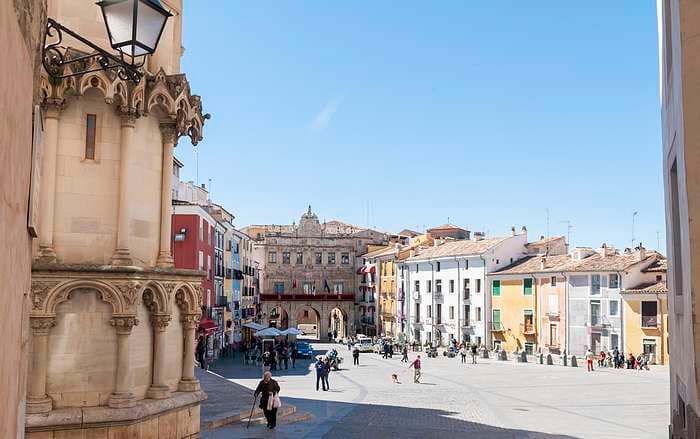
Plaza Mayor of Cuenca
Landmark
The baroque heart of the upper town, ringed by arcades and dominated by the cathedral's neoclassical façade. The terraces of local cafés offer an ideal vantage point for observing life in Cuenca away from the beaten tourist trail. Wikipedia (es) - CC BY-SA
Museum of Spanish Abstract Art
Landmark
Housed within the Casas Colgadas themselves, this museum founded in 1966 showcases a major collection of Spanish abstract art featuring Chillida, Tàpies, Saura and Zóbel. An exceptional setting for an equally exceptional collection. Wikipedia (es) - CC BY-SA
San Pablo Bridge
Landmark
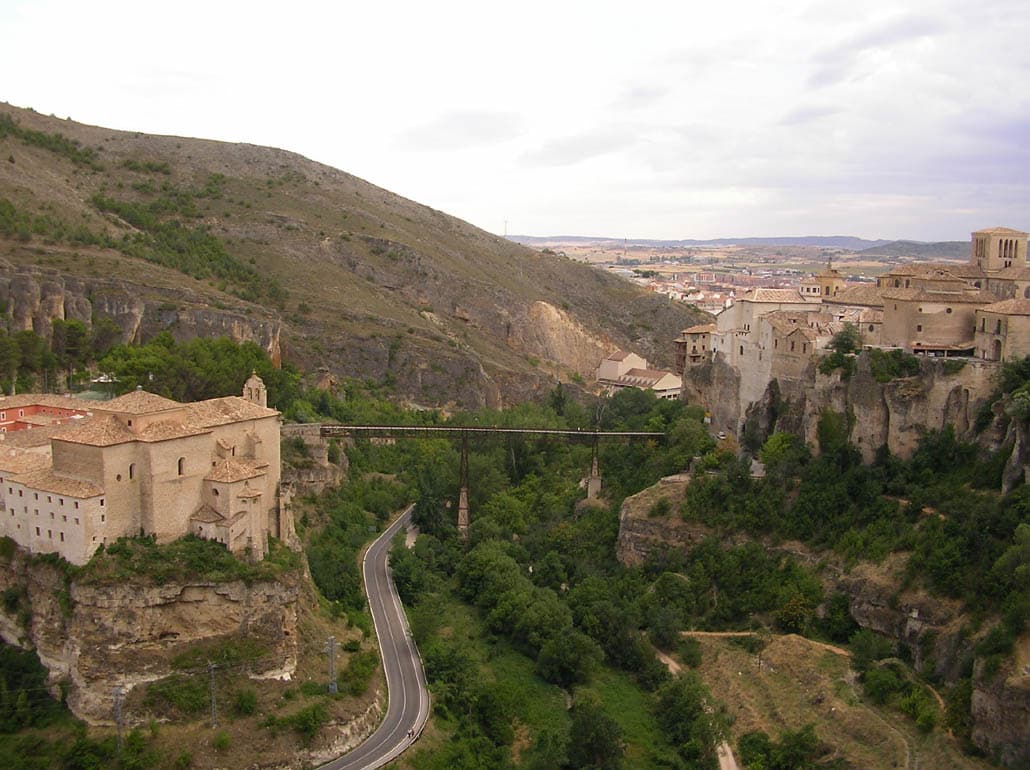
Suspended metal footbridge above the Huécar gorges offering Cuenca's most photographed view. Built in 1902 on the site of an earlier stone bridge, it connects the upper town to the parador. Wikipedia (es) - CC BY-SA
Museum of Cuenca
Landmark
An archaeological and ethnographic museum tracing the region's history from prehistory through the Roman and medieval periods. The collection of Roman bronzes from Ercávica is particularly outstanding. Wikipedia (es) - CC BY-SA
Arco de Bezudo
Landmark
A medieval gateway providing access to the upper town, a well-preserved remnant of 12th-century ramparts. Bypassed by hurried tourists, it marks the entrance to the authentic historic quarter. Wikipedia (fr) - CC BY-SA
Cuenca Cathedral
Landmark
Spain's first Norman Gothic cathedral, begun in the 12th century on a former Almohad mosque. The interior blends Gothic, Renaissance and contemporary art with stained glass by modern artists.Church of San Miguel
Landmark
A 12th-century Romanesque church perched on the promontory of the upper town, now serving as a concert hall. Its crenellated tower and commanding position above the gorges make it one of the most discreet yet most beautiful viewpoints in the city.Hanging Houses of Cuenca
Landmark
14th-century houses suspended from the Hoz del Huécar cliff face are the absolute symbol of the city. The view from San Pablo Bridge is breathtaking, especially during golden hour.Nature & parks (2)
 Wikipedia (es) - CC BY-SA
Hoz del Huécar
Nature
A limestone gorge carved by the Huécar river at the foot of the historic town, reached on foot from the centre. The path along the river offers vertiginous views of the cliffs and suspended houses from below. Wikipedia (es) - CC BY-SA
Hoz del Júcar
Nature
The Júcar gorge plunges between 100-metre cliffs on the western side of the upper town. Less celebrated than its Huécar counterpart, it delivers near-certain solitude and remarkable riparian vegetation.Viewpoints (3)
 Wikipedia (es) - CC BY-SA
Mirador de Mangana
Viewpoint
A watchtower converted into a belvedere overlooking the lower town and the endless plains of La Mancha. Facing away from the gorges, it's ideal at sunset when raking light illuminates the Serranía. Wikipedia (es) - CC BY-SA
Mirador del Castillo de Cuenca
Viewpoint
Ruins of an Almohad fortress crowning the rocky outcrop, offering a 360° panorama across the Júcar and Huécar gorges. The highest point of the upper town, often deserted outside weekends.Mirador de Puente de San Pablo (Huécar bank)
Viewpoint
Earthen path following the right bank of the Huécar from the parador, with a frontal view of the Casas Colgadas and the suspended bridge. The locals' preferred photographic perspective, away from the footbridge crowds.Activities (3)
 Wikipedia (es) - CC BY-SA
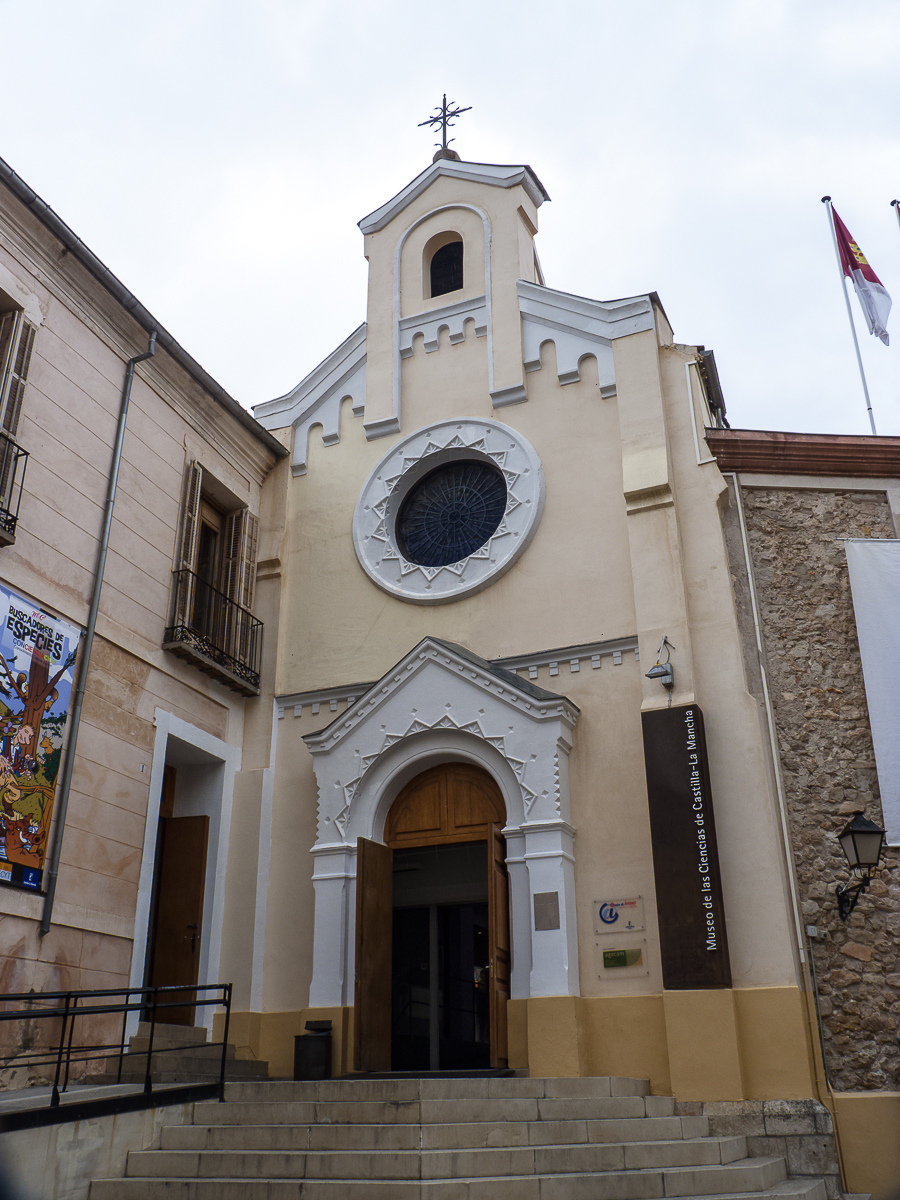
Museum of Sciences of Castilla-La Mancha
Activity
Interactive science museum housed in a former Dominican convent, featuring an astronomy section and permanent exhibition on the geology of the Serranía. Perfect for families, yet often overlooked by cultural visitors. Wikipedia (es) - CC BY-SA
Fundación Antonio Pérez
Activity
Contemporary and singular art foundation housed in a 17th-century convent, with a collection of appropriated objects and Spanish conceptual art. One of Spain's most original and unconventional collections.Palaeolithic Route - Las Majolicas Archaeological Site
Activity
Open-air Palaeolithic archaeological site with interpretive panels and waymarked trail through Cuenca's pine forests. A 3 km walk blending prehistoric history with nature, virtually absent from tourist guides.More to discover (2)
 Wikipedia (es) - CC BY-SA
Convent of San Pablo (Parador de Cuenca)
Place
16th-century former Dominican convent now a national parador, accessible to non-residents to explore the Renaissance cloister and enjoy coffee on the terrace with direct views of the Casas Colgadas.Castillo District - Calle de las Canónigos
Place
Medieval cobbled alley connecting the cathedral to the castle ruins, lined with remarkably intact 15th-century noble houses. One of the old town's most authentic urban stretches, well away from the main tourist flow.