🇧🇪Belgium · Places to discover
What to see in Bruges?
47 places selected by the community - landmarks, nature, hidden restaurants and activities.
Bruges operates at a different pace from the rest of Europe. Its canals, Flemish brick façades and the Markt square form a medieval ensemble that was never rebuilt after a war-it simply fell into economic obscurity in the nineteenth century, which preserved it by accident. The city is small, dense, and reads on foot within a few hours.
Spring (April–May) and autumn offer reasonable footfall and light befitting its character. Two days suffice to tour it without rushing. You arrive by train from Brussels in less than an hour-no need to rent a car; the centre is pedestrian. Avoid the brasseries that line the Markt itself-the beer is the same, but the price reflects only the address.
Landmarks & heritage
14 places
 1Wikimedia Commons · CC BY 3.0
Landmark
Saint John's Hospital (Memling in Sint-Jan)
A former medieval hospital from the 12th century, now converted into a museum dedicated to Hans Memling. The Shrine of Saint Ursula, a true painted miniature cathedral, is one of the most precious works of Flemish art.
 2Wikimedia Commons · CC BY-SA 3.0
Landmark
Béguinage of Bruges
A haven of peace on the banks of the Lake of Love, founded in 1245 and UNESCO-listed. The Beguines have been replaced by Benedictine nuns, but the timeless atmosphere remains intact – especially in spring when daffodils carpet the courtyard.
 3Wikimedia Commons · CC BY-SA 4.0
Landmark
Bruges Town Hall
One of the oldest town halls in Belgium (1376), with a flamboyant Gothic façade adorned with statues. The interior Gothic hall with polychrome wooden vaults is an absolute masterpiece often underestimated.
 4Wikimedia Commons · CC BY-SA 3.0
Landmark
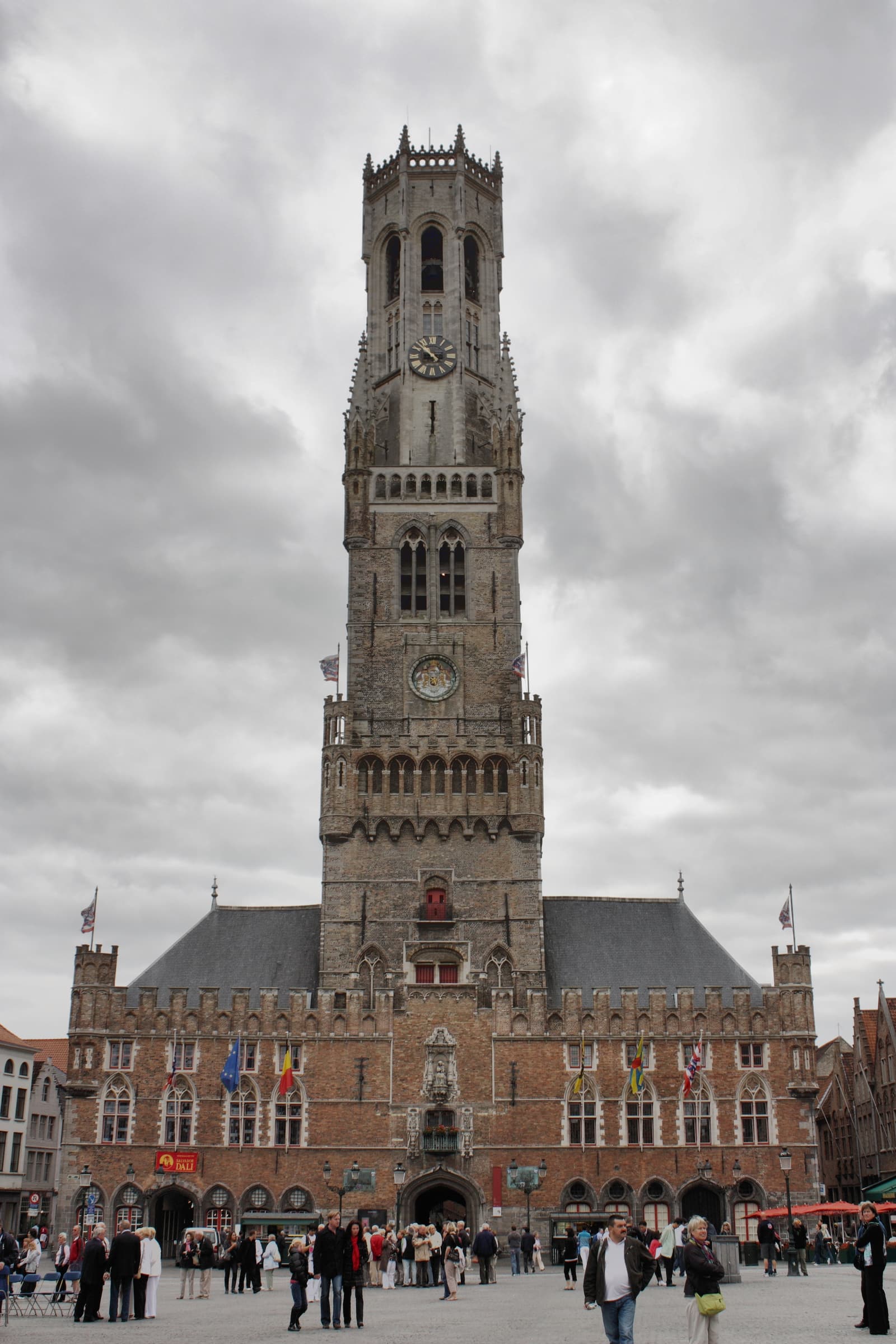
Belfry of Bruges
A medieval tower 83 metres high dominating the Grand-Place, with 366 steps leading to a panoramic view over red-tiled rooftops. The carillon of 47 bells rings every hour – a moment suspended in time.
 5Wikimedia Commons · CC BY-SA 3.0
Landmark
Stadhuis van Damme
A 15th-century Gothic town hall, architectural jewel of Damme's Grand Place. Its sculptured façade and belfry testify to the town's medieval commercial power.
 6Wikipedia · CC BY-SA 4.0
Landmark
Gand Gate (Gentpoort)
The best-preserved of Bruges' four medieval gates, dating from the 14th century, with its two massive round towers. The small free interior museum explains the city's defensive system – often overlooked in favour of the belfry.
 7Wikimedia Commons · CC BY-SA 4.0
Landmark
Huis De Grote Sterre
A 15th-century Gothic patrician house, one of Flanders' best preserved examples. Its stepped-gable façade perfectly illustrates the medieval bourgeois architecture of the period.
 8Wikimedia Commons · CC BY-SA 3.0
Landmark
Sint-Janshospitaal Damme
A former 13th-century medieval hospital, now converted into a municipal museum. It houses exceptional period furniture and recounts Damme's history as an outport of Bruges.
- 9
Landmark
Landmark
Remains of the Medieval City Walls
Vestiges of Damme's medieval ramparts, visible as grassy embankments partially encircling the village. A testimony to the town's strategic importance as a defensive stronghold for Bruges.
- 10
Landmark
Landmark
Damse Vaart beside Bruges – Damme Lock
The historic lock marks the entrance to the canal in Damme and forms a picturesque passage point. Pleasure boats passing through the lock create authentic activity far removed from any staged atmosphere.
- 11
Landmark
Landmark
Hoeve Ten Doorn
Medieval fortified farmhouse surrounded by a moat, visible from the polder paths north of Damme. One of the rare examples of a fortified Flemish farm still in agricultural use in the region.
- 12
Landmark
Landmark
Standbeeld Till Uilenspiegel
Statue of the famous folk character Till Uilenspiegel, brought to literary life in Damme by Charles De Coster. A potent symbol of identity for the region's inhabitants.
- 13
Landmark
Landmark
Huis Sint-Jan
A 15th-century civil Gothic building facing the Church of Our Lady, formerly a merchant house. Its sober elegance contrasts with the surrounding tourist bustle and recalls Damme's mercantile past.
- 14
Landmark
Landmark
Onze-Lieve-Vrouwekerk Damme
An imposing 13th-century Gothic church whose truncated tower has become Damme's emblem. The interior houses remarkable sculptures and offers panoramic views from the top of the tower.
Museums
4 places
 15Wikimedia Commons · CC BY-SA 3.0
Museum
Groeninge Museum
One of the world's most important collections of Flemish Masters – Van Eyck, Memling, Bosch. Memling's diptych of Maarten van Nieuwenhove alone is worth the trip for anyone interested in painting.
 16Wikimedia Commons · CC BY-SA 4.0
Museum
Choco-Story (Chocolate Museum)
An interactive museum tracing the history of cacao from the Mayas to Belgian chocolatiers. The praline-making demonstration with final tasting even convinces sceptics of thematic museums.
- 17
Museum
Museum
Till Uilenspiegel Museum
Small museum dedicated to the legendary character of Till Uilenspiegel, hero of Charles De Coster's novel set in Damme. Collections of illustrations, rare editions and folklore objects linked to this symbol of Flemish resistance.
- 18
Museum
Museum
Bruges Diamond Museum (Diamantmuseum)
Bruges was the birthplace of modern diamond cutting in the 15th century – a little-known fact that this museum traces brilliantly. The live cutting demonstrations are fascinating and included with admission.
Religious sites
4 places
 19Wikimedia Commons · CC BY 3.0
Religious site
Church of Jerusalem (Jeruzalemkerk)
A 15th-century private chapel built by the Adornes family modelled on the Church of the Holy Sepulchre in Jerusalem, unique in Belgium. Still owned by the founding family – an absolutely fascinating living anachronism.
 20Wikimedia Commons · CC BY 2.0
Religious site
Church of Our Lady, Bruges
Its tower of 122 metres is the second-highest brick structure in the world. It houses Michelangelo's Madonna of Bruges, the only sculpture by the master to have left Italy during his lifetime.
- 21
Religious site
Religious site
Chapel of Our Lady of Comfort
Small devotional chapel nestled in verdant surroundings on the outskirts of Damme. A discreet pilgrimage site frequented by village residents, with a rare atmosphere of contemplation.
- 22
Religious site
Religious site
Holy Blood Basilica
Small Romanesque-Gothic jewel nestled on the Burg, housing a relic of Christ's blood brought back from the Crusades. The Romanesque lower chapel from the 12th century is often overlooked by hurried tourists – yet it is the oldest in Bruges.
Castles & fortresses
1 place
 23Wikimedia Commons · CC BY 2.0
Castle
Gruuthuse Palace
Magnificent 15th-century Gothic palace that belonged to the powerful Gruuthuse family, recently renovated and reopened. The private gallery opening directly onto Notre-Dame church is a fascinating architectural detail.
Nature
6 places
 24Wikimedia Commons · CC BY-SA 3.0
Nature
Damse Vaart
A straight Napoleonic canal linking Damme to Bruges, lined with rows of century-old poplars on either side. An ideal spot for cycling or walking, with open views across the surrounding polders.
 25Wikimedia Commons · CC BY-SA 4.0
Nature
Polder Region Damme
Vast landscape of flat, open polders extending north of Damme, crisscrossed by ditches and farm tracks. A playground for ornithologists and lovers of silent, wide-open spaces.
- 26
Nature
Nature
Doornzeelse Kreek
A former tidal channel transformed into a wet nature reserve on the edge of Damme. Frequented by herons, ducks and grebes, it is a corner of absolute tranquillity away from marked trails.
- 27
Nature
Nature
Astrid Park
Bruges' main public park, with its rose garden and ponds, is where local families gather on weekends. Less touristy than Minnewater, it offers a genuine slice of local life.
- 28
Nature
Nature
Coupure District Waterways
The Coupure canal, excavated in the 18th century, is lined with century-old trees and bourgeois townhouses. Less frequented than central canals, this is where Bruges residents cycle on Sunday mornings.
- 29
Nature
Nature
Minnewater (Lake of Love)
A former medieval harbour basin that has become one of Bruges' most romantic spots. Early in the morning, before the crowds, swans glide across mirror-like water framed by weeping willows—a postcard image that never loses its charm.
Parks & gardens
2 places
 30Wikimedia Commons · CC BY-SA 3.0
Park
Princes-Bishops' Palace Garden (Hof Bladelin)
A 15th-century Renaissance courtyard, once the seat of the Medici bank in Bruges, now discreetly accessible from the street. A well-kept local secret in the heart of the merchant quarter.
- 31
Park
Park
Minnewater Park
Tree-lined park running alongside the Lake of Love as far as the béguinage, ideal for a stroll without traffic or noise. Locals come here to picnic and read, far from the crowds of the centre – a true green lung of Bruges.
Viewpoints
7 places
 32Wikimedia Commons · CC BY 3.0
Viewpoint
Rozenhoedkaai
The Rosary Quay is THE iconic viewpoint of Bruges—belfry in the background, canals in the foreground, gabled houses bathed in evening light. Come at golden hour for photos without the midday crowds.
- 33
Viewpoint
Viewpoint
Weidse Polder Horizon at Hoeke
The hamlet of Hoeke, north of Damme, offers the most unobstructed polder horizon in the municipality. On clear days, Dutch wind turbines and the church steeple of Sluis are visible on the horizon.
- 34
Viewpoint
Viewpoint
Schellemolen Windmill
Eighteenth-century wooden windmill perched on an earth levee overlooking the polders. One of the still-operating mills in the region, it offers an iconic viewpoint over the Flemish landscape.
- 35
Viewpoint
Viewpoint
Poplar Avenue on Damse Vaart towards Sluis
Northern section of the canal towards the Dutch border, less frequented than the Bruges side. Late afternoon light filtering through the poplars creates striking photographic effects on the still water.
- 36
Viewpoint
Viewpoint
Panorama from Onze-Lieve-Vrouwekerk Tower
From the top of the church's truncated tower, your gaze sweeps across the polders to Bruges and the North Sea on clear days. A 360° view over a Flemish landscape unchanged for centuries.
- 37
Viewpoint
Viewpoint
Boniface Bridge (Bonifaciusbrug)
A small romantic stone bridge spanning a narrow canal between gardens and Gothic façades, often described as Bruges' most beautiful bridge. Despite its reputation, it remains surprisingly quiet outside the season.
- 38
Viewpoint
Viewpoint
Bruges Windmills (Windmills of Kruisvest)
Four windmills punctuate the eastern rampart of the city, two of which are still operational. A walk along the old ramparts between the mills offers a bucolic panorama and a unique perspective on Bruges' rooftops.
Activities
6 places
 39Wikimedia Commons · CC BY 3.0
Activity
Boekenmarkt Damme
Damme claims the title of 'book city' and houses permanent antiquarian booksellers in its old houses. Browsing through thousands of rare Flemish, French and English books in this medieval setting is a unique experience.
- 40
Activity
Activity
Walking Route Damme-Sijsele through the Polders
Signposted walking trail crossing the polders between Damme and the neighbouring village of Sijsele. Approximately 8 km there and back through open agricultural landscape, dotted with ditches and isolated farms.
- 41
Activity
Activity
Boat Trip on the Damse Vaart
Boat excursion between Damme and Bruges along the Napoleonic canal, with commentary on the region's history. A unique way to see the poplars and polders from the water.
- 42
Activity
Activity
Damme Fietsverhuur Cycle Hire
Ideal starting point to explore the polders and canal by bicycle. Signposted routes from Damme allow you to reach Bruges (7 km) or the Belgian-Dutch border without a car.
- 43
Activity
Activity
Cycle Hire and Rampart Tour
Bruges is best experienced by bicycle like its inhabitants—the complete rampart tour covers 7 km and passes mills, medieval gates and authentic residential quarters. Fietsen Popelier rents quality bikes at reasonable prices.
- 44
Activity
Activity
Punt tour of the canals
Five landing points offer 30-minute tours through Bruges' inner canals, under low bridges and past façades inaccessible on foot. Opt for the Dijver landing point, less crowded than Rozenhoedkaai.
More to discover
3 places
- 45
Place
Place
Boerenhof Damme – Local Farmers' Market
Seasonal farmers' market where producers from Damme's polders sell vegetables, artisanal cheeses and charcuterie. An opportunity to meet local farmers and leave with a 100% polder basket.
- 46
Place
Place
Saturday Morning Market (Markt and 't Zand)
Every Saturday morning, the market fills 't Zand square and overflows into the Markt – seasonal fruits and vegetables, artisanal cheeses and cut flowers at producer prices. This is where locals shop, not in souvenir boutiques.
- 47
Place
Place
Sint-Anna Quarter and its Alleyways
Bruges' most authentic neighbourhood, with low fishermen's cottages, small canals and a village-like atmosphere within the city. Carmersstraat and its artist studios make it an ideal spot for wandering without a plan.
Also 🇧🇪 in Belgium