🇧🇪Belgium · Places to discover
What to see in Mechelen?
31 places selected by the community - landmarks, nature, hidden restaurants and activities.
Mechelen occupies a singular position between Brussels and Antwerp without truly belonging to either's orbit. The town served as capital of the Habsburg Netherlands in the 16th century, and this former ambition still reads in the unfinished silhouette of the cathedral Saint-Rombaut, whose tower dominates the red-brick roofline. The historic centre remains human-scaled, crossed by the Dyle, with a local life not yet entirely formatted for tourism.
Two days suffice for serious exploration, including the Musée Hof van Busleyden, which traces Mechelen's golden age with careful scenography. Spring and autumn are the pleasantest seasons; summer brings excursion groups from Brussels who saturate the Grote Markt at midday - better to visit early. The train from Brussels-Central takes eighteen minutes, making it an easy stop without a car.
Landmarks & heritage
10 places
 1Wikimedia Commons · CC BY-SA 4.0
Landmark
Hof van Busleyden
16th-century Renaissance palace converted into an exceptional municipal museum tracing Mechelen's golden age under the Habsburgs. The inner courtyard and painted rooms are magnificent.
 2Wikimedia Commons · CC BY 4.0
Landmark
Kazerne Dossin
Memorial, museum and documentation centre on the Holocaust and human rights, installed in the barracks from which 25,000 Jews and Roma were deported. An essential and deeply moving place of remembrance.
 3Wikipedia · CC BY-SA 3.0
Landmark
Begijnhof of Lier
Beguinage listed as a UNESCO World Heritage site, founded in the 13th century. Its paved lanes and whitewashed houses form a village within the town of absolute serenity, just steps from the centre.
 4Wikimedia Commons · CC BY-SA 3.0
Landmark
Groot Begijnhof Mechelen (Great Béguinage of Mechelen)
One of Belgium's largest béguinages, a UNESCO World Heritage site, with cobbled lanes and 17th-century gable houses. Completely peaceful just steps from the bustling city centre.
 5Wikimedia Commons · CC BY-SA 3.0
Landmark
Mechelen Town Hall
Composite city hall on the Grand-Place combining the gothic Palace of the Grand Council and the unfinished Cloth Hall, creating a unique facade in Europe. A symbol of the city's Burgundian power.
 6Wikimedia Commons · CC BY-SA 4.0
Landmark
Onze-Lieve-Vrouw-over-de-Dijlekerk
Gothic church on the banks of the Dyle housing a Rubens triptych depicting the Miraculous Catch of Fish, often overlooked by rushed visitors. The Baroque interior is of astonishing richness.
 7Wikipedia · CC BY-SA 3.0
Landmark
Schepenhuis – Former Aldermen's Hall
A 14th-century Gothic building on the banks of the Dyle, one of the oldest courthouse halls in the southern Netherlands. Today a cultural space hosting exhibitions and concerts in intact medieval surroundings.
 8Wikimedia Commons · CC BY 4.0
Landmark
Sint-Janskerk Mechelen
This 15th-century church houses Rubens' triptych of the Adoration of the Magi, commissioned in 1619. Less frequented than the cathedral, it offers a more intimate artistic experience.
 9Wikimedia Commons · CC BY-SA 3.0
Landmark
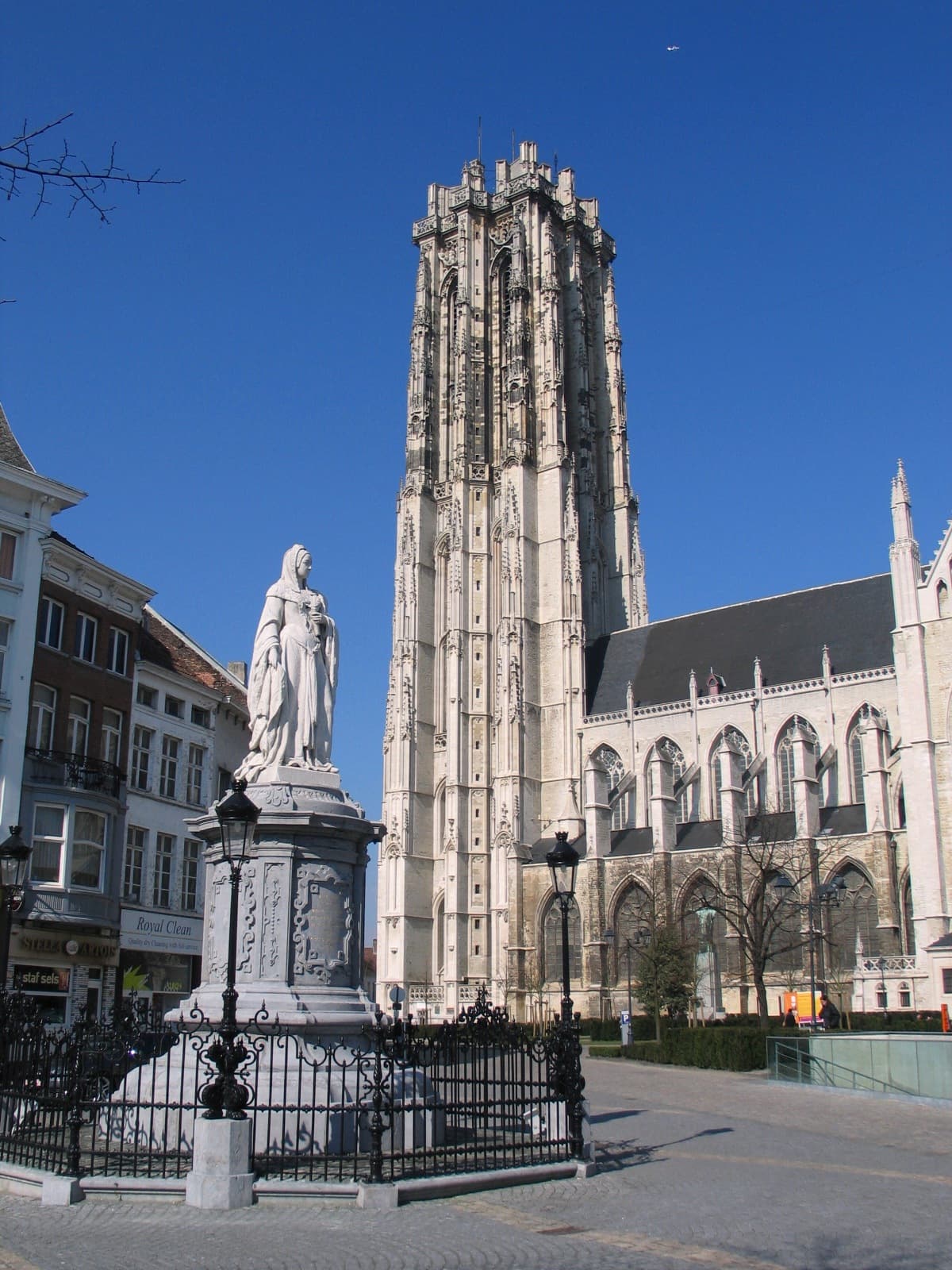
Sint-Romboutskathedraal (St Rombout's Cathedral)
The Gothic cathedral whose unfinished tower reaches 97 metres and is the symbol of Mechelen. Climbing to the top offers breathtaking views over Flemish rooftops and the Dyle's meanders.
 10Wikimedia Commons · CC BY-SA 4.0
Landmark
Gate of Lier – River Gate
Remnant of the town's former medieval fortifications, this brick gateway spans the Kleine Nete. It offers one of the finest photographic angles in Lier, especially at sunset.
Museums
1 place
- 11
Museum
Museum
Lier Lace Museum – Kantcentrum
Living workshop-museum where lacemakers perpetuate the tradition of bobbin lace, a historic speciality of Lier. Live demonstrations reveal the complexity of this textile art.
Religious sites
2 places
 12Wikimedia Commons
Religious site
Abbey Refuge of Sint-Truiden
A discreet 16th-century monastic refuge nestled in an alley of the Befferstraat district, with a well-preserved late Gothic façade. A perfect example of the hidden heritage found in Mechlin's narrow streets.
- 13
Religious site
Religious site
Kapelmuur – Chapel Wall
Remnant of the medieval inner fortifications, this thirteenth-century brick wall is woven into the urban fabric of the beguinage. A raw fragment of history that few visitors notice.
Castles & fortresses
1 place
 14Wikimedia Commons · CC BY-SA 3.0
Castle
Palais van Margareta van Oostenrijk (Palace of Margaret of Austria)
The former palace of regent Margaret of Austria, now a courthouse, is one of the earliest Renaissance buildings in the Netherlands. The inner courtyard can be visited discreetly and is well worth seeing.
Nature
5 places
 15Wikimedia Commons · CC BY-SA 4.0
Nature
Vrijbroekpark
Landscaped park of 55 hectares to the east of the city, famous for its rose garden in June and wet meadows along the Dyle. Ideal for a long walk away from tourist circuits.
- 16
Nature
Nature
Netepark
Large municipal park bordering the Nete, popular with Lier families and joggers. Its century-old trees, pond and picnic areas make it the city's green lung.
- 17
Nature
Nature
Ramparts Promenade – City Walls
Walking path that follows the town's former medieval ramparts along the Nete. Residents meet here in the morning to run or stroll, far from conventional tourist circuits.
- 18
Nature
Nature
Mechelen City Park
Large urban park laid out on former ramparts with ponds, ducks and century-old trees. The green lung of Mechelen for morning jogs or Sunday picnics.
- 19
Nature
Nature
Dijlepad – Dyle Waterfront Promenade
The promenade along the Dyle river winds through Mechelen's historic heart between colourful quays and gabled houses reflected in the water. A walking or cycling route that locals use daily.
Parks & gardens
1 place
- 20
Park
Park
Speelpleinpark Lier – Nete Play Park
Family park beside the Nete with natural play areas, community gardens and barbecue space. A neighbourhood gathering place where you can observe authentic Lier sociability away from tourist trails.
Viewpoints
3 places
 21Wikimedia Commons · CC BY-SA 3.0
Viewpoint
Refuge of Tongerlo Abbey
Renaissance façade hidden in an alley behind the Grand-Place, remnant of the former refuge of Tongerlo Abbey. Few tourists venture there, yet it is a discreet architectural gem.
 22Wikimedia Commons · CC BY-SA 4.0
Viewpoint
Haverwerf – Grain Quay
Mechelen's most photographed medieval quay, with three 16th-century half-timbered houses reflected in the Dyle. In the evening, café terraces enliven this postcard corner.
- 23
Viewpoint
Viewpoint
View from the top of Sint-Rombouts Tower
The panorama at 97 metres high reveals the Antwerp plain, polders and on clear days the skyscrapers of Antwerp. The climb of 514 steps is rewarded with an absolutely unique 360° view.
Activities
6 places
 24Wikimedia Commons · CC BY-SA 4.0
Activity
Speelgoedmuseum Mechelen
Toy museum among Europe's largest with 50,000 pieces tracing the history of play from 1750 to today. Fascinating for both children and nostalgic adults.
 25Wikimedia Commons · CC BY-SA 3.0
Activity
Timmermans-Opsomer House
Museum dedicated to both writer Timmermans and painter Isidore Opsomer, two major figures in Lier's cultural life. An intimate place of memory that reveals the unexpected artistic wealth of this small town.
 26Wikimedia Commons · CC BY-SA 3.0
Activity
Planckendael Zoo
Zoo and conservation park 5 km from the centre, managed by Antwerp Zoo, specialising in breeding endangered species. The space is immense and natural enclosures make one forget captivity.
- 27
Activity
Activity
Saturday Market – Grand-Place
The weekly Saturday morning market fills the Grand-Place and surrounding streets with local greengrocers, artisanal cheese makers and florists. Where Mechelen residents shop and meet for a coffee.
- 28
Activity
Activity
Velo-City – Bike Hire and Rampart Circuit
Mechelen is best explored by bike along the former ramparts converted into a cycle path encircling the old town. Local rental shops offer cargo bikes and off-the-beaten-path themed routes.
- 29
Activity
Activity
Koninklijke Beiaardschool Mechelen
Mechlin is the world capital of the carillon – the Royal School of Campanology trains campanologists from around the globe. The carillon concerts from the cathedral tower on Sunday mornings are a rare privilege.
More to discover
2 places
- 30
Place
Place
Sint-Katelijnestraat and Befferstraat – Local Commercial Heart
These two pedestrian streets beloved by locals blend independent fashion boutiques, Flemish bookshops and delicatessens without a single international chain. The antithesis of standardised high streets.
- 31
Place
Place
Battelsesteenweg – Antique District
This thoroughfare and its adjacent lanes concentrate around a dozen independent antique dealers and second-hand shops specialising in Flemish furniture and religious objects. An essential browsing route on Saturday mornings.
Also 🇧🇪 in Belgium