🇦🇹Austria · Places to discover
What to see in Innsbruck?
22 places selected by the community - landmarks, nature, hidden restaurants and activities.
Innsbruck functions according to a vertical logic: the town stretches through a valley hemmed in by two Alpine massifs, and inhabitants move from the historic centre to the slopes in under twenty minutes. The Old Town around the Goldenes Dachl-that fifteenth-century roof of gilt copper tiles-reminds you that the city was once an Habsburg capital before becoming a dual Olympic host.
Spring (May–June) and autumn offer the best conditions: hiking is accessible without summer crowds, and prices drop. Two days are enough for the centre, three if you take the Nordkette cable car. Avoid the restaurants immediately around Maria-Theresien-Strasse, which live solely off passing trade: local addresses are found in the alleyways north of the Inn.
Landmarks & heritage
8 places
 1Wikimedia Commons · CC BY-SA 3.0
Landmark
Stadtturm Tower
Medieval tower from the 14th century at the heart of the old town, with a panoramic platform at 31 metres offering a 360° view of the rooftops and surrounding mountains. Climb 148 steps and the reward is guaranteed.
 2Wikimedia Commons · CC BY-SA 3.0
Landmark
Bergisel Sprungschanze
Ski jump designed by Zaha Hadid, perched at 746 metres altitude. The panoramic café at the summit offers a breathtaking view over Innsbruck and the Inn valley – accessible by funicular.
 3Wikimedia Commons · CC BY-SA 2.5
Landmark
Annasäule
Marian column erected in 1706, planted at the centre of Maria-Theresien-Straße with the snow-capped Nordkette as a backdrop. One of the most photographed urban perspectives in Tyrol, and for good reason.
 4Wikimedia Commons · CC BY-SA 3.0
Landmark
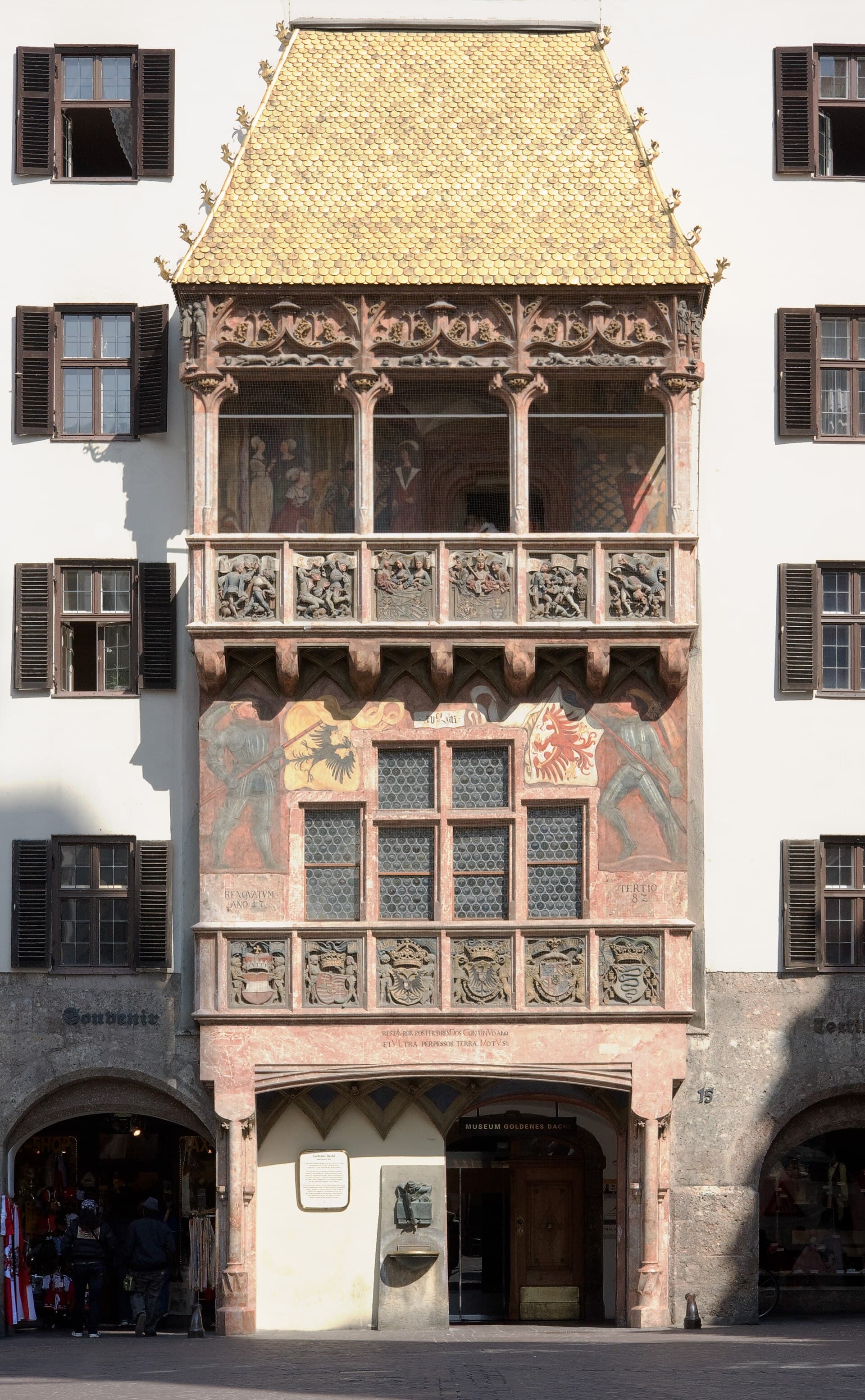
Goldenes Dachl
Imperial balcony from the 15th century covered with 2,657 gilded copper tiles, commissioned by Maximilian I. An absolute symbol of Innsbruck, and truly a late Gothic masterpiece often underrated by those who don't look up.
 5Wikimedia Commons
Landmark
Hofburg Innsbruck
Imperial palace of the Habsburgs rebuilt in the 18th century in striking Viennese baroque style. The Hall of Giants with its full-length portraits of the imperial family is well worth the visit, far from the Vienna crowds.
 6Wikimedia Commons · CC BY-SA 3.0
Landmark
Hofkirche and Tomb of Maximilian I
Renaissance church housing the monumental cenotaph of Maximilian I surrounded by 28 life-sized bronze statues. One of the most impressive sculptural ensembles in Central Europe, often overlooked in favour of the Goldenes Dachl.
 7Wikimedia Commons · CC BY-SA 2.0
Landmark
Triumphpforte
Baroque triumphal arch erected in 1765 for the wedding of Leopold II, with one joyful face and one mournful face commemorating the death of Francis I. Set in the middle of Maria-Theresien-Straße, it catches the eye from far away.
- 8
Landmark
Landmark
Innsbruck Old Town – Kiebachgasse Lane
Small paved lane behind the Hofburg, with preserved Renaissance and Baroque façades and artisan workshops. Less frequented than Herzog-Friedrich-Straße, it shows Innsbruck before mass tourism.
Museums
2 places
 9Wikimedia Commons · CC BY-SA 3.0
Museum
Tiroler Volkskunstmuseum
Museum of Tyrolean folk arts housed in the former Franciscan monastery adjacent to the Hofkirche. Reconstructed peasant interiors, traditional costumes and carved nativity scenes – a dive into Alpine culture often underappreciated.
 10Wikimedia Commons · CC BY-SA 4.0
Museum
Tiroler Landesmuseum Ferdinandeum
Tyrol's principal museum covering archaeology, fine arts and regional history. Its collection of Tyrolean Gothic paintings and works by Cranach the Elder make it essential for understanding Alpine art.
Religious sites
2 places
 11Wikipedia · CC BY-SA 3.0
Religious site
Wiltener Basilika
Baroque basilica in Wilten (1755), south of Innsbruck, with a stunning Rococo interior and a Romanesque Madonna venerated since the Middle Ages. Off the usual tourist circuits, it is nonetheless one of Tyrol's finest churches.
 12Wikimedia Commons · CC BY-SA 3.0
Religious site
Stift Wilten – Premonstratensian Abbey
Premonstratensian abbey founded in the 12th century, featuring a Baroque abbey church from the 17th century and a cloister still inhabited by monks. Adjacent to the basilica, they form a remarkable monastic ensemble.
Castles & fortresses
1 place
 13Wikimedia Commons · CC BY-SA 4.0
Castle
Schloss Ambras
16th-century Renaissance castle of Archduke Ferdinand II, featuring the world's oldest armoury of heroes and a curiosity cabinet that founded modern museums. Nestled in a verdant park above the city.
Nature
2 places
- 14
Nature
Nature
Sill Gorge
Wild gorge carved by the Sill river just minutes from the city centre, often overlooked by tourists. A trail runs along the rock walls and passes under the arches of the railway viaduct – raw nature within 15 minutes' walk of the Goldenes Dachl.
- 15
Nature
Nature
Innufer – Promenade between Innbrücke and Universitätsbrücke
Banks of the Inn between the two main bridges, with a direct view of the colourful facades of the Altstadt reflected in the turquoise river. The locals' favourite spot for morning jogs or evening aperitifs.
Viewpoints
4 places
 16Wikimedia Commons · CC BY-SA 3.0
Viewpoint
Nordkette – Hafelekar (2334 m)
Summit accessible from the city centre in 30 minutes via the Hungerburgbahn and two cable cars. Stunning views across the Alpine chain and the Inn valley – locals head up here to hike whenever the weather permits.
- 17
Viewpoint
Viewpoint
Innbrücke – View of the Coloured Houses of the Inn
From the old Inn bridge, the row of coloured medieval façades (Mariahilf) is reflected in the turquoise waters of the river with the Nordkette in the background. The authentic postcard of Innsbruck, at sunrise.
- 18
Viewpoint
Viewpoint
Panoramaweg Innsbruck – Gramartboden Trail
Hiking trail accessible from Hungerburg offering a sweeping view over Innsbruck and the Inn valley. Frequented by local residents in the morning, it combines larch forest and Alpine panoramas without requiring specialist equipment.
- 19
Viewpoint
Viewpoint
Seegrube (1905 m) – Panoramic Terrace
Intermediate station of the Nordkettenbahn with a suspended terrace overlooking the city. Ideal for coffee facing the Alps in summer or for watching paragliders launching just next door.
Activities
3 places
 20Wikimedia Commons · CC BY-SA 4.0
Activity
Alpenzoo Innsbruck
Europe's highest-altitude zoo (750 m), dedicated exclusively to Alpine fauna: lynx, brown bears, bearded vultures. Accessible by the Hungerburgbahn, it offers a rare experience even for non-zoo enthusiasts.
 21Wikimedia Commons · CC BY 4.0
Activity
Hungerburgbahn – Congress Station
Hybrid funicular designed by Zaha Hadid connecting Innsbruck's city centre to Hungerburg. The stations with organic forms reminiscent of iced shells are artworks in themselves, not to be missed.
- 22
Activity
Activity
Kletteranlage Innsbruck – Climbing Centre
Austria's leading climbing centre, frequented by local climbers and competition athletes. Indoor and outdoor walls with routes for all levels – the spirit of Tyrolean climbing indoors.
Also 🇦🇹 in Austria