🇦🇹Austria · Places to discover
What to see in Salzburg?
22 places selected by the community - landmarks, nature, hidden restaurants and activities.
Salzbourg makes more sense when you forget about Mozart. Or rather, when you stop looking for him everywhere. The baroque city built on two hills overlooking the Salzach has a rare architectural coherence in Central Europe, shaped for centuries by prince-archbishops. Festung Hohensalzburg towering above the orange roofs and Getreidegasse below it together capture that tension between religious power and commercial life.
Spring (April–May) and early autumn offer the city without the summer saturation of the Festival. Two days are enough to explore on foot; the city is compact and public transport covers the outer quarters well. Skip the snowglobe and Mozart chocolate shops squeezing the Getreidegasse: they take up space without saying anything about the place. Instead, cross the river into the Lehen neighbourhood to see where Salzburgers actually live.
Landmarks & heritage
4 places
 1Wikimedia Commons · CC BY-SA 3.0
Landmark
Hallstatt Ossuary
A unique ossuary chapel worldwide where the skulls of the deceased are adorned with painted flowers and calligraphed names, due to lack of space in the cemetery. A local funerary tradition dating back to the 18th century.
 2Wikimedia Commons · CC BY-SA 3.0
Landmark
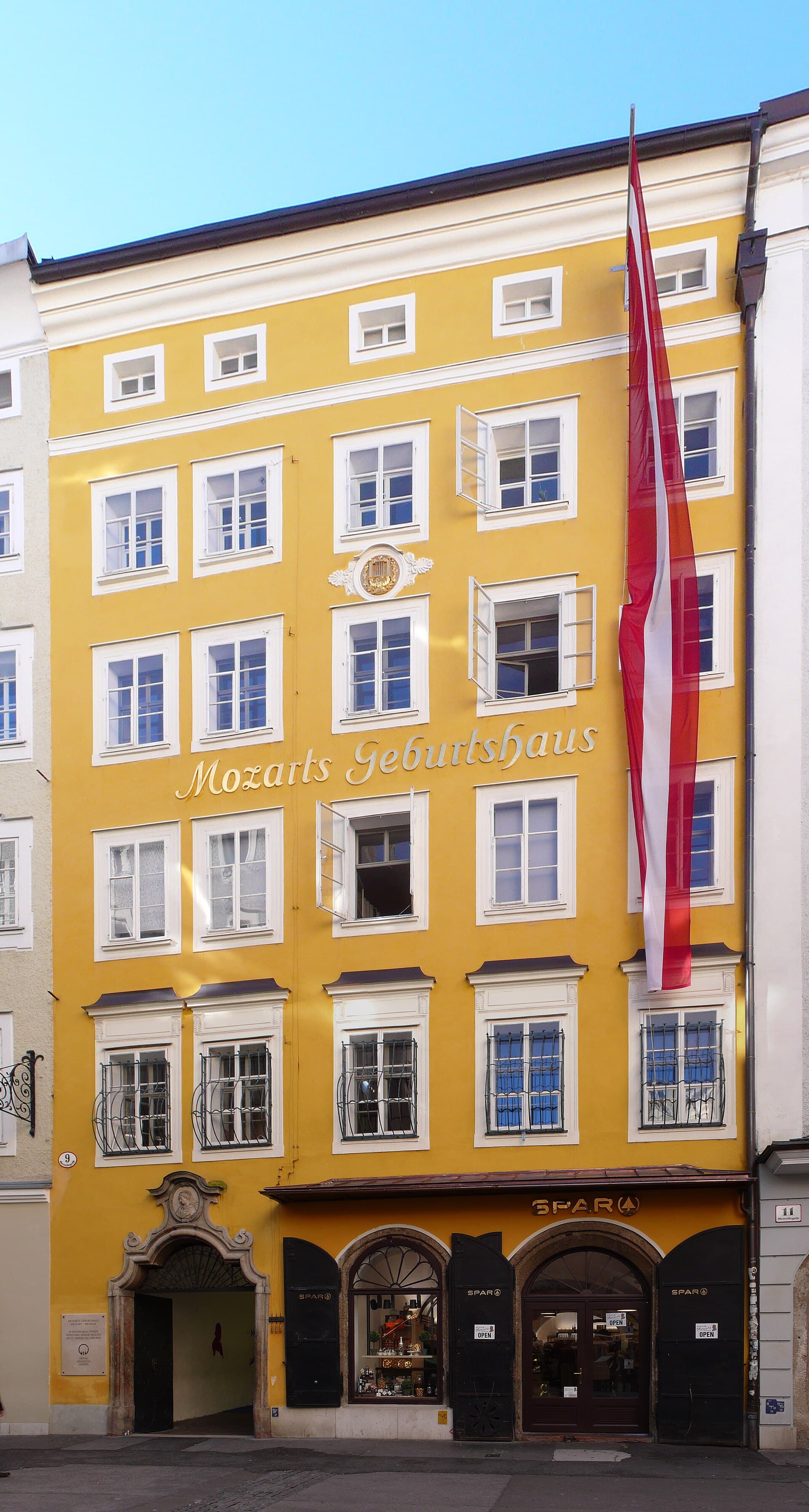
Mozart's Birthhouse
Mozart's birthplace at 9 Getreidegasse, in an 18th-century bourgeois building. Less grand than the Wohnhaus, it preserves an authentic atmosphere with the composer's childhood instruments.
 3Wikimedia Commons · CC BY 3.0
Landmark
Residenz Salzburg
The former residence of the prince-archbishops in the heart of the old town, with state rooms lavished in gold and a gallery of Flemish and Dutch paintings often overlooked. The Residenzplatz with its Baroque fountain is the beating heart of the city.
- 4
Landmark
Landmark
St Sebastian Cemetery
Mannerist cemetery from the 16th century with the archbishop Wolf Dietrich's chapel-mausoleum, and the graves of the Mozart family and physician Paracelsus. One of the old town's most peaceful and least visited spaces.
Museums
1 place
 5Wikimedia Commons · CC BY-SA 4.0
Museum
Museum der Moderne Mönchsberg
Contemporary art museum perched on the edge of the Mönchsberg cliff, with a restaurant terrace offering one of the city's finest panoramas. The programme features emerging Austrian artists and cutting-edge international exhibitions.
Religious sites
4 places
 6Wikimedia Commons · CC BY-SA 4.0
Religious site
Nonnberg Abbey
The world's oldest Benedictine convent in the German-speaking lands, in continuous operation since 714, perched on a rocky terrace above the old town. Made famous by The Sound of Music, it remains a genuine monastic community – discretion requested.
 7Wikimedia Commons · CC BY-SA 3.0
Religious site
Salzburg Cathedral
17th-century Baroque cathedral where Mozart was baptised, with a striking white marble façade overlooking Domplatz. The domed interior and historic organs well justify entry.
 8Wikimedia Commons · CC BY 2.5
Religious site
Kollegienkirche
A masterpiece by Johann Bernhard Fischer von Erlach, considered one of the finest baroque churches in the German-speaking world. Its concave façade and refined interior form a sober contrast to the surrounding exuberance.
 9Wikimedia Commons
Religious site
Stiftskirche Saint Peter
Austria's oldest church still in use, founded in 696, with a rock cemetery carved into the Mönchsberg cliff. The catacombs hewn into the rock are a secret few visitors explore.
Castles & fortresses
3 places
 10Wikimedia Commons · CC BY 2.5
Castle
Hellbrunn Palace
17th-century pleasure palace renowned for its mechanical water features that soak visitors without warning – a tradition since 1619. The adjoining zoo and tree-lined avenues make it an ideal half-day excursion outside the city centre.
 11Wikimedia Commons · CC BY-SA 3.0
Castle
Mirabell Palace
Baroque palace built for Prince-Archbishop Wolf Dietrich, with the French gardens immortalised in The Sound of Music. Enter the Marmorsaal for evening concerts—exceptional acoustics.
 12Wikimedia Commons · CC BY-SA 4.0
Castle
Festung Hohensalzburg
One of Europe's best-preserved medieval fortresses, perched 120 metres above the city. The climb on foot via Festungsgasse is preferable to the funicular for grasping the scale of the monument.
Nature
4 places
 13Wikimedia Commons · CC BY 2.5
Nature
Hellbrunner Allee
A two-kilometre tree-lined avenue connecting the city to Hellbrunn Palace, designated a natural monument. Popular with Salzburg cyclists and joggers, it is one of Austria's finest green corridors.
 14Wikimedia Commons · CC BY-SA 3.0
Nature
Kapuzinerberg
The wooded hill on the right bank, less crowded than Mönchsberg, with a 17th-century Way of the Cross leading to the Capuchin convent. From the summit, the sweeping views over the Salzach and the old town's rooftops are simply spectacular.
 15Wikimedia Commons · CC BY-SA 4.0
Nature
Gaisberg Summit
The Gaisberg peak at 1,287m, accessible by bus from the city centre, offers 360° views across the Alps and the Salzburg plain. Locals hike up for summer sunsets and winter snowshoe treks.
- 16
Nature
Nature
Salzachufer Promenade
The banks of the Salzach between Staatsbrücke and Mozartsteg, on the left bank, are the open-air living room of Salzburg's residents. In the evening, the reflections of baroque façades in the river's green water are of rare beauty.
Viewpoints
2 places
 17Wikimedia Commons · CC BY-SA 4.0
Viewpoint
Mönchsberg Viewpoint
The natural terrace of Mönchsberg offers the most honest panorama of the old town and Festung, without the crowds of the funicular. Accessible on foot from Augustinergasse in 15 minutes; locals come here to picnic.
- 18
Viewpoint
Viewpoint
Mozartsteg
A suspended pedestrian bridge over the Salzach, offering an ideal vantage point of the old town from the right bank. Locals use it daily—watching the flow of cyclists and pedestrians at sunset is a simple, free pleasure.
Activities
3 places
 19Wikimedia Commons
Activity
Getreidegasse
The historic shopping street of the old town with its wrought-iron shop signs – each shop has displayed its metal heraldic shield since the Middle Ages. Visit early in the morning before the tourist rush to capture the atmosphere of a merchant town.
- 20
Activity
Activity
Haus der Natur Salzburg
Natural history museum across five floors with aquarium, reptilarium and a remarkable astronomy section. Less well-known than the city's Baroque museums, it captivates both adults and children with its Alpine meteorite collections.
- 21
Activity
Activity
Salzburg Marionette Theatre
Puppet theatre founded in 1913, the world's most renowned of its kind, staging entire operas with hand-articulated puppets. Book well in advance for performances of The Magic Flute.
More to discover
1 place
 22Wikimedia Commons · CC BY 3.0
Place
Steingasse
Salzburg's most intact medieval alley, squeezed between the Kapuzinerberg cliff and the Salzach, with 14th-century houses. This is where the old Roman road once passed – the atmosphere is incomparable at dusk.
Also 🇦🇹 in Austria