🇦🇹Austria · Places to discover
What to see in Vienna?
24 places selected by the community - landmarks, nature, hidden restaurants and activities.
Vienna operates on two registers simultaneously: that of an imperial capital that long dictated European taste, and that of a neighbourhood city where residents read their newspaper at a café for hours without pressure. The Ringstrasse concentrates this tension between deliberate grandeur and ordinary life, whilst the Naschmarkt remains where the city has provisioned itself and gathered for centuries.
Spring (April-May) and autumn offer reasonable light and visitor numbers; allow four days to get below the surface. The U-Bahn is dense and punctual, no need to hire anything. The classic trap: exhausting yourself in the Museumsquartier museums in a single day when each deserves half a day separately.
Landmarks & heritage
7 places
 1Wikimedia Commons · CC BY-SA 4.0
Landmark
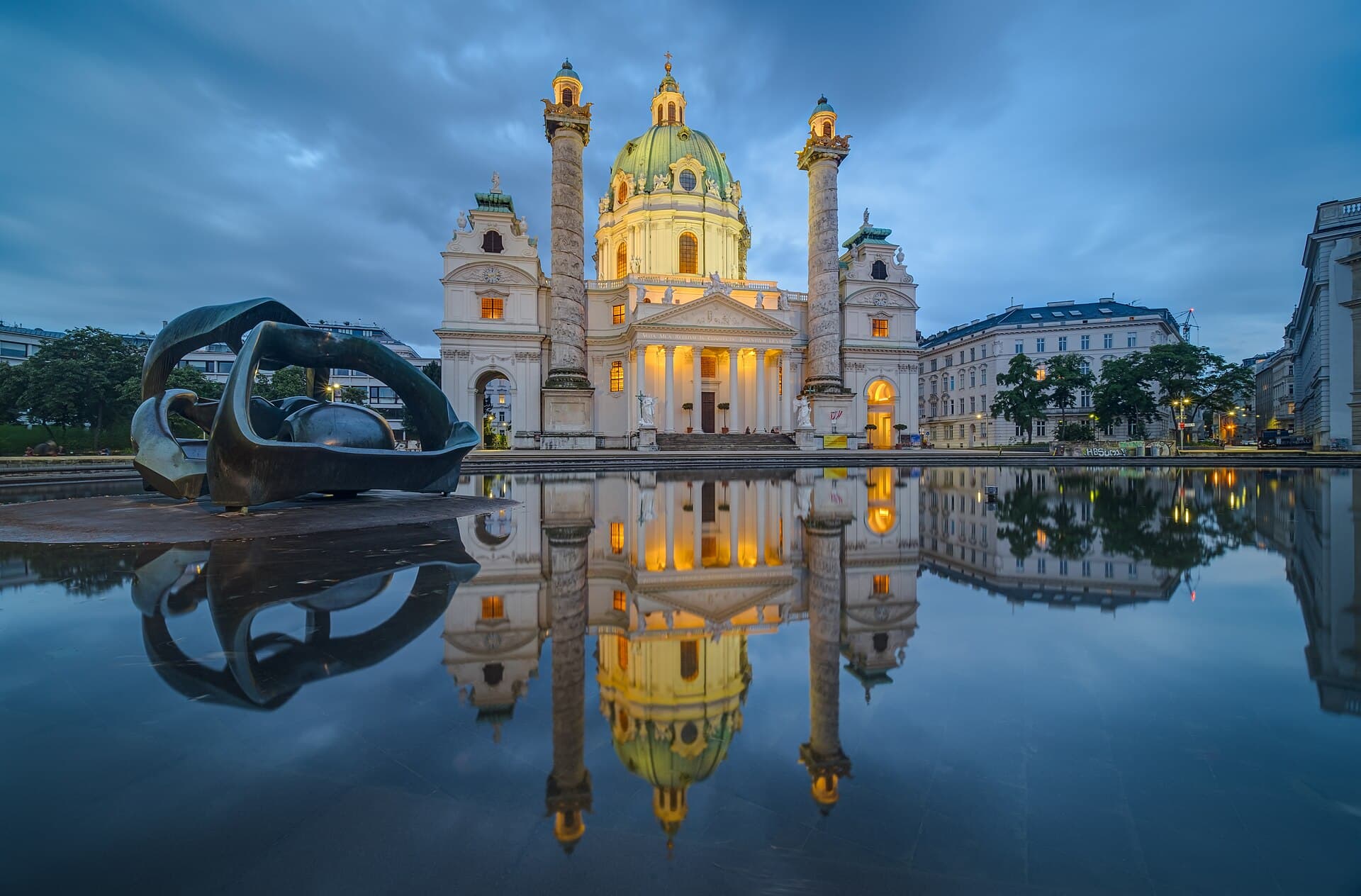
Karlskirche
Baroque masterpiece by Johann Bernhard Fischer von Erlach, dominating Karlsplatz with its twisted columns inspired by Trajan's Column. The interior houses a panoramic elevator up to the dome's frescoes – a unique experience.
 2Wikimedia Commons
Landmark
Friedensreich Hundertwasser - KunstHausWien
Museum entirely dedicated to Hundertwasser, designed by the artist himself with its undulating floors and ceramic mosaics. More intimate and honest than the house opposite transformed into a souvenir shop.
 3Wikimedia Commons · CC BY-SA 4.0
Landmark
Hundertwasserhaus
Residential building designed by Friedensreich Hundertwasser, with undulating façades, trees growing through windows and uneven floors. A living manifesto against linear architecture – and people actually live here.
 4Wikimedia Commons · CC BY-SA 4.0
Landmark
Peterskirche
Small Baroque church often overlooked in favour of the nearby Stephansdom, yet one of Vienna's finest. The gilded interior and illusionistic ceiling frescoes are well worth a visit.
 5Wikimedia Commons · CC BY-SA 2.0
Landmark
Zentralfriedhof
One of Europe's largest cemeteries, where Beethoven, Brahms, Schubert, Strauss and Schönberg rest side by side. A favourite Sunday walk for Viennese – strange and magnificent.
- 6
Landmark
Landmark
Augustinerkirche
Court church of the Habsburgs, site of the wedding of Marie-Thérèse and Francis Joseph. The Herzgruft contains urns holding the hearts of the imperial family—a macabre yet fascinating detail little known.
- 7
Landmark
Landmark
Secession
Temple of Viennese Art Nouveau built in 1897 by Joseph Maria Olbrich, with its gilded dome nicknamed the 'golden cabbage'. Permanently houses Klimt's Beethoven Frieze, a masterpiece rarely highlighted.
Museums
3 places
 8Wikimedia Commons
Museum
MAK - Museum für angewandte Kunst
Museum of applied arts housing an exceptional Wiener Werkstätte collection and an often-overlooked Klimt room. The museum café with its Ring terrace is one of the city's most pleasant.
 9Wikimedia Commons · CC BY-SA 4.0
Museum
Technisches Museum Wien
Technical museum often overlooked by tourists but beloved by locals for its full-scale steam machines, locomotives and interactive demonstrations. Ideal with or without children.
- 10
Museum
Museum
Kunsthistorisches Museum
One of the world's largest art museums, housing the Habsburg collection—Vermeer, Bruegel, Velázquez, Cellini. The café beneath the dome is an exceptional place to rest, even without a museum ticket.
Religious sites
2 places
 11Wikimedia Commons · CC BY-SA 4.0
Religious site
St Stephen's Cathedral
The Gothic cathedral at Vienna's heart, with its instantly recognisable glazed tile roof. Climb the South Tower for sweeping city views – far less crowded than the north lift.
 12Wikimedia Commons · CC BY-SA 4.0
Religious site
Votivkirche
Neo-Gothic church erected as thanksgiving after the failed assassination attempt on Francis Joseph in 1853. Its white stone façade and two soaring spires dominate the Ringstraße—less touristy than the Stephansdom but architecturally sublime.
Nature
3 places
 13Wikimedia Commons · CC BY-SA 3.0
Nature
Lainzer Tiergarten
Former imperial hunting reserve of 2,450 hectares, now a protected nature park home to wild boar and deer roaming freely. Viennese come here for genuine forest hikes, away from tourist trails.
 14Wikimedia Commons · CC BY-SA 3.0
Nature
Donauinsel
Artificial island 21 km long created to protect Vienna from Danube flooding. Residents flock here massively in summer to swim, cycle, bathe and picnic—the soul of the city's summer.
 15Wikimedia Commons · CC BY-SA 4.0
Nature
Augarten
Europe's oldest public baroque park (1775), located in the 2nd district, with its two Second World War anti-aircraft towers still standing – silent witnesses to history. Locals come here to play tennis and pétanque.
Parks & gardens
2 places
 16Wikimedia Commons · CC BY-SA 3.0
Park
Türkenschanzpark
Romantic 18th district park, unknown to tourists, with its artificial ruins, ponds and pergolas. The favourite neighbourhood park for Viennese families and students.
 17Wikimedia Commons · CC BY-SA 4.0
Park
Upper Belvedere – Gardens
The French formal gardens of the Belvedere offer one of Vienna's finest framed views, with the Baroque palace as backdrop. Early morning, before the tour groups, feels almost intimate.
Viewpoints
2 places
 18Wikimedia Commons · CC BY-SA 4.0
Viewpoint
Kahlenberg
Hill rising to 484m above the city from the heights of the Viennese Forest, with a panoramic terrace overlooking the entire Vienna basin and Hungarian plains. Locals cycle or take the bus here at weekends to get some fresh air.
- 19
Viewpoint
Viewpoint
Prater and Giant Wheel (Riesenrad)
The 1897 giant wheel offers panoramic views of Vienna from its period wooden cabins. The surrounding Prater is a vast popular park where Viennese run, picnic and cycle—far from the amusement park image.
Activities
4 places
 20Wikimedia Commons
Activity
Brunnenmarkt
Vienna's longest street market in the multicultural Ottakring district, with Turkish, Yugoslav and African stalls. Less polished than Naschmarkt, more lively and authentic – the real face of popular Vienna.
 21Wikimedia Commons · CC BY 2.0
Activity
Wiener Konzerthaus
Concert hall inaugurated in 1913, a more intimate alternative to the Musikverein, with an eclectic programme from classical to jazz. Last-minute Stehplatz (standing) tickets are available for under €10.
 22Wikimedia Commons · CC BY-SA 4.0
Activity
Naschmarkt
Vienna's largest market with 120 stalls of spices, cheeses, olives, fish and specialities from around the world. Saturday morning, the adjacent flea market attracts hunters and browsers – arrive early.
- 23
Activity
Activity
Musikverein - Standing Tickets
The Musikverein's Golden Hall is one of the most beautiful and acoustically perfect concert halls in the world. Standing tickets (Stehplätze) sold an hour before the concert allow you to attend the same programmes as subscribers for just a few euros.
More to discover
1 place
- 24
Place
Place
Spittelberg
Preserved Biedermeier quarter in the 7th district, with its cobbled lanes, colourful 18th-century houses and independent art galleries. In the evening, its neighbourhood restaurants and bars attract a local and creative clientele.
Also 🇦🇹 in Austria