🇱🇺Luxembourg · Places to discover
What to see in Luxembourg-Ville?
23 places selected by the community - landmarks, nature, hidden restaurants and activities.
Luxembourg-Ville harbours a paradox: a European capital with 130,000 inhabitants that operates at the rhythm of a provincial town. What defines it is radical topography - the old town perched on sandstone cliffs, carved out by the gorges of the Pétrusse and Alzette. The Chemin de la Corniche traces these precipices with almost surgical precision, whilst the Casemates du Bock reveal an underground network that tells the military history of the place far better than any museum.
Spring and autumn offer clearer light than summer, which is often misty. Two days are enough to cover the essentials without hurrying. The bus network has been free since 2020 - a practical detail that genuinely improves getting around. Skip the Kirchberg European quarter on a Sunday: it's empty and unrewarding outside weekdays.
Landmarks & heritage
5 places
 1Wikimedia Commons · CC BY-SA 4.0
Landmark
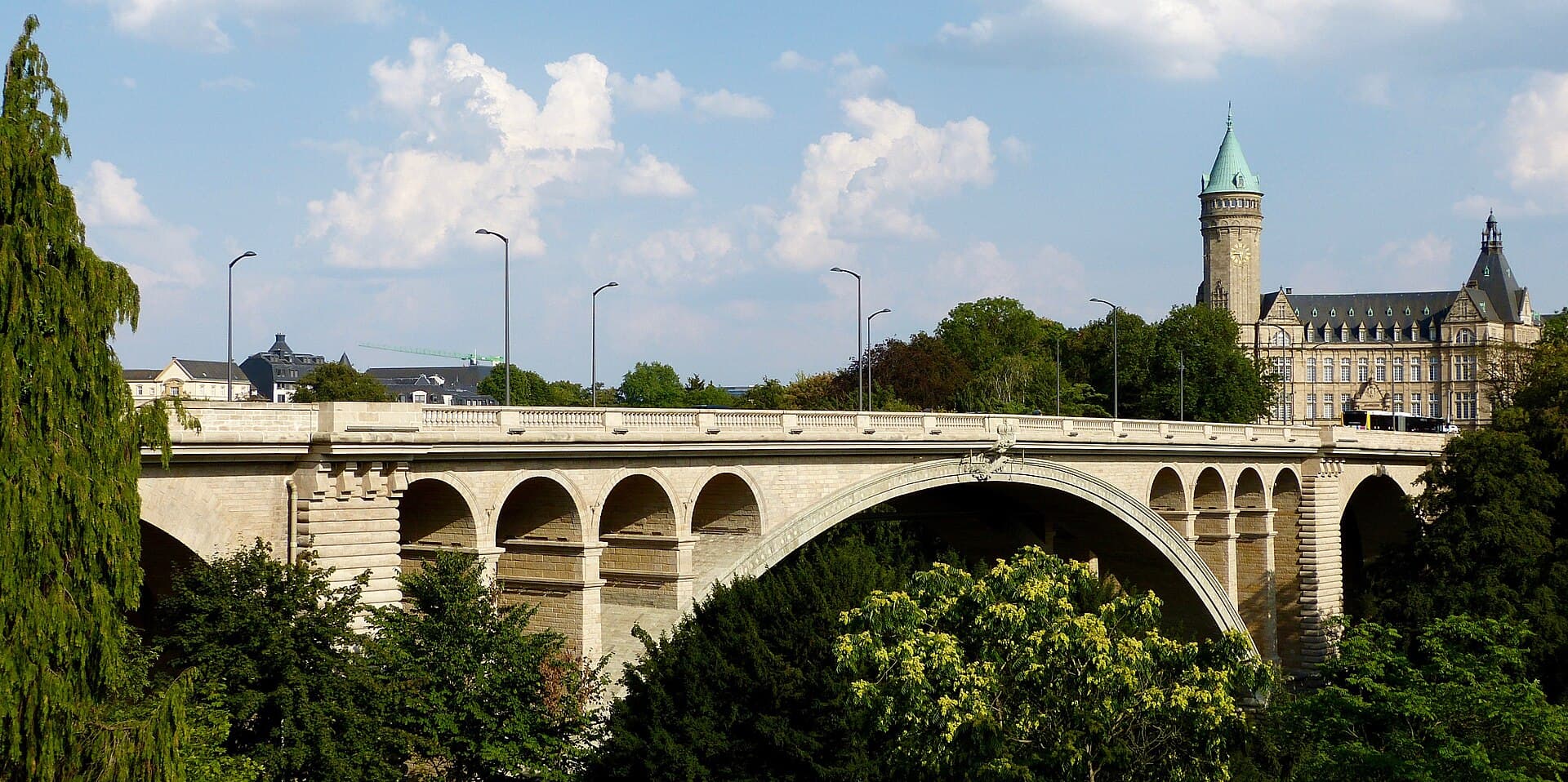
Adolphe Bridge
A 1903 stone bridge spanning the Pétrusse valley at 46 m height – one of the city's symbols. The view from the bridge over the two valleys is breathtaking.
 2Wikimedia Commons · CC BY-SA 3.0
Landmark
William II Square
Lively heart of the old town with its twice-weekly market of local producers. The equestrian statue of William II and the Neo-Classical Town Hall frame a vibrant public space.
- 3
Landmark
Landmark
Gate of Three Towers
One of the few medieval gates still standing, dating from the 14th century, in the Grund district. Often overlooked by hurried tourists, it bears witness to the town's original fortifications.
- 4
Landmark
Landmark
Casemates of the Bock
A network of underground galleries carved into sandstone over 17 km, UNESCO-listed. A former impregnable fortress that shaped European military history.
- 5
Landmark
Landmark
Beim Renert
Double Michelin-starred Luxembourg gastronomic restaurant, embodying the new cuisine of the Grand Duchy's terroir. Short menu, local products, memorable experience.
Museums
3 places
 6Wikimedia Commons · CC BY-SA 3.0
Museum
Mudam Luxembourg - Grand Duke Jean Contemporary Art Museum
Leading contemporary art museum in a building by I.M. Pei, integrated into the ruins of Fort Thüngen. International collections and ambitious temporary exhibitions, open Wednesday evenings.
 7Wikimedia Commons · CC BY-SA 4.0
Museum
Fort Thüngen (Musée Dräi Eechelen)
A restored former fortification housing the fortress history museum of Luxembourg. Located on the Kirchberg, it offers a unique perspective on the city's military stratification.
- 8
Museum
Museum
National Museum of History and Art (MNHA)
The essential museum of Luxembourg history, from the Celts to the present day. The archaeological section and Flemish fine art gallery are worth a visit – often overlooked by tourists.
Religious sites
3 places
 9Wikimedia Commons · CC BY-SA 4.0
Religious site
Neumünster Abbey
Former 17th-century Benedictine abbey converted into a European cultural centre in the Grund. Concerts, debates, exhibitions—the living cultural heart of the lower town.
 10Wikimedia Commons · CC BY 3.0
Religious site
Notre-Dame Cathedral of Luxembourg
A Baroque gem from the 17th century blending late Gothic and Renaissance. The crypt houses the tombs of the grand-ducal family – sober and moving.
- 11
Religious site
Religious site
Saint-Jean-du-Grund Church
Small 17th-century Carmelite Baroque church nestled at the bottom of the valley, with a black Madonna venerated by Luxembourgers. Intimate and peaceful setting, far from tourist bustle.
Castles & fortresses
1 place
 12Wikimedia Commons · CC BY-SA 4.0
Castle
Grand-Ducal Palace
Official residence of the Grand Duke, built in the 16th century in the heart of the old town. The changing of the guard and summer guided visits make it a discreet must-see.
Nature
2 places
 13Wikimedia Commons · CC BY 2.0
Nature
Alzette Valley - Grund District
Luxembourg's most picturesque neighbourhood, nestled at the bottom of the valley. Cobbled streets, suspended gardens, hidden bistros—the secret city that commuters never see.
 14Wikimedia Commons · CC BY-SA 4.0
Nature
Clausen District - Alzette Riverbanks
Former brewery neighbourhood transformed into a trendy bar and restaurant zone along the Alzette. The riverside walk between Clausen and the Grund is one of the city's finest.
Parks & gardens
3 places
 15Wikimedia Commons · CC BY-SA 2.0
Park
Pétrusse Park
Linear park winding through the bottom of the Pétrusse valley, beneath the Adolphe Bridge. Perfect for a restorative walk between districts, with lush vegetation that belies its urban setting.
- 16
Park
Park
Pescatore Park
Discreet botanical garden in the Limpertsberg neighbourhood, with its greenhouses, ducks and countryside atmosphere in the city. A haunt of morning joggers and Sunday retirees.
- 17
Park
Park
Bock Rock
Rocky outcrop that founded the city, offering a vertiginous view over the Alzette valley and the casemates. It was here that Count Sigefroi built the first castle in 963.
Viewpoints
4 places
 18Wikimedia Commons · CC BY-SA 4.0
Viewpoint
Philharmonie Terrace
The Philharmonie du Kirchberg's esplanade offers an unexpected panorama over the European plateau and the lower town. Architecture by Christian de Portzamparc, spectacular at sunset.
 19Wikimedia Commons · CC BY-SA 4.0
Viewpoint
Grand Duchess Charlotte Bridge (Red Bridge)
Red metal bridge from 1966 linking the Kirchberg plateau to the upper town, 74m above the Alzette valley. Spectacular view of the casemates and Bock from the pedestrian footpath.
- 20
Viewpoint
Viewpoint
Pfaffenthal Viewpoint
Overlooked vantage point over the triple valley from the upper town, accessible by a free panoramic lift. The best photograph of Luxembourg is taken from here, without the crowds of the Corniche.
- 21
Viewpoint
Viewpoint
Corniche Path
Nicknamed 'Europe's most beautiful balcony', this pedestrian path runs along the medieval ramparts above the Grund. An unobstructed view over the red roofs and the Alzette valley.
Activities
2 places
 22Wikimedia Commons · CC BY-SA 3.0
Activity
Casino Luxembourg - Contemporary Art Forum
Experimental contemporary art space housed in a former Belle Époque casino. Cutting-edge programming, often free entry—the place where the local art scene meets.
- 23
Activity
Activity
Limpertsberg Market
Authentic neighbourhood market on Saturday mornings, frequented by local residents and expatriates of Limpertsberg. Local producers, Luxembourgish cheeses, flowers – the antidote to tourist markets.
Also 🇱🇺 in Luxembourg